
Building an AI model is easy, testing it properly isn’t.
I’ve seen teams spend months fine-tuning models, only to realize later that their chatbot gives confident but completely wrong answers. That’s where proper NLP testing comes in and in 2026, it’s no longer optional.
In this post, I’ll walk you through five of the best NLP testing tools you can actually use today, along with practical advice on how to evaluate AI models without overcomplicating things.
Why NLP Testing Tools Are Essential in 2026
If you’ve worked with language models recently, you already know the biggest issue: they sound right even when they’re wrong.
Hallucinations, bias, and inconsistency aren’t edge cases anymore they show up in real deployments. I once tested a healthcare chatbot that confidently suggested the wrong dosage. That’s not just a bug, that’s a risk.
Here’s what’s changed recently:
- Models are more powerful but also more unpredictable
- Bias still sneaks in, especially with real-world prompts
- Model drift happens faster with changing data
NLP testing today is about trust, not just accuracy. If you’re not testing your model regularly, you’re basically guessing.
Read more: https://garminlive.com/what-is-a-smart-tv-2026-beginners-guide-to-features-types/
Key Features to Look for in NLP Testing Tools
Accuracy & Benchmarking
At the core, you need solid NLP evaluation metrics. The usual suspects still matter:
- Precision & Recall
- F1 Score
- BLEU and ROUGE
But from what I’ve seen, many teams rely too heavily on these numbers. They’re useful, but they don’t always reflect real-world performance.
A better approach? Combine metrics with human-like evaluation scenarios. Compare outputs with expected answers but also check if responses make sense.
Bias & Fairness Detection
Bias in NLP models is subtle. It doesn’t always show up in obvious ways.
For example, I once tested a hiring assistant that consistently preferred male-associated language. It wasn’t intentional but it was there.
Good NLP QA tools should help you:
- Detect gender or racial bias
- Evaluate fairness across datasets
- Test edge demographic cases
Many people overlook this until it becomes a public issue.
Robustness & Stress Testing
This is where things get interesting.
Real users don’t type clean, perfect sentences. They use slang, mix languages, and make typos.
Your model should handle inputs like:
- “plz tell me best resturant near me rn”
- Code-switched language (e.g., English + Urdu)
- Incomplete queries
If it breaks under messy input, it’s not production-ready.
Automation & Integration
Manual testing doesn’t scale. Period.
Modern NLP testing frameworks should integrate with your CI/CD pipeline so you can:
- Run automated tests on every update
- Track performance changes over time
- Catch regressions early
If your testing process isn’t automated, it’ll get skipped. I’ve seen that happen too often.
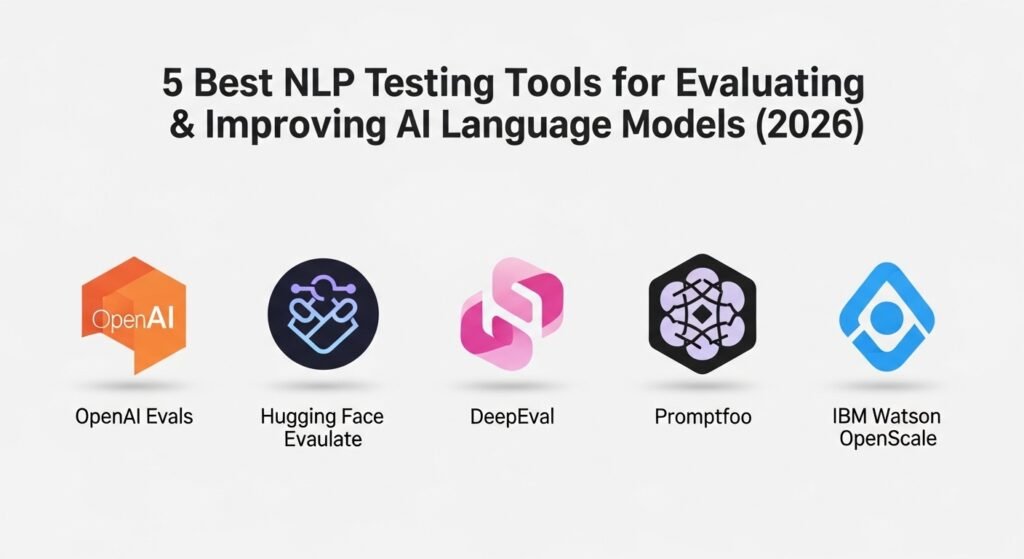
5 Best NLP Testing Tools in 2026
1. OpenAI Evals
This is one of the most practical tools for testing LLM models.
What I like about OpenAI Evals is its flexibility. You can create custom evaluation datasets tailored to your use case customer support, medical queries, coding, anything.
It’s especially useful for:
- Prompt evaluation
- Benchmarking GPT-style models
- Automated scoring
If you’re already working with LLMs, this feels like a natural starting point.
2. Hugging Face Evaluate
If you’ve used transformers before, this tool fits right in.
Hugging Face Evaluate is lightweight, open-source, and very developer-friendly. It supports a wide range of NLP benchmarking tools and metrics.
What stands out:
- Easy integration with existing pipelines
- Pre-built metrics (BLEU, ROUGE, etc.)
- Strong community support
It’s not flashy, but it gets the job done efficiently.
3. DeepEval
DeepEval is built specifically for modern LLM testing, and it shows.
From what I’ve tested, it focuses heavily on:
- LLM output quality
- Semantic evaluation
- Debugging responses
It also supports automation, which makes it useful for continuous NLP performance testing.
If you’re struggling with vague or inconsistent outputs, this tool helps you pinpoint why.
4. Promptfoo
This one is a favorite among prompt engineers.
Promptfoo is designed for testing prompts rather than models themselves. And honestly, that’s more important than many realize.
You can:
- Run A/B tests on prompts
- Compare outputs across models
- Optimize prompt structure
In real-world projects, small prompt tweaks can outperform major model changes.
5. IBM Watson OpenScale
This is more of an enterprise-grade AI testing platform.
IBM Watson OpenScale goes beyond testing it focuses on monitoring, governance, and compliance.
Best suited for:
- Large-scale deployments
- Regulated industries
- AI lifecycle management
It’s not lightweight, but if you need reliability and compliance, it’s worth considering.
Comparison Table (Quick Overview)
| Tool | Best For | Key Feature |
|---|---|---|
| OpenAI Evals | LLM testing | Custom evaluation datasets |
| Hugging Face Evaluate | Developers & researchers | Built-in NLP metrics |
| DeepEval | LLM debugging | Semantic evaluation |
| Promptfoo | Prompt engineering | A/B prompt testing |
| IBM Watson OpenScale | Enterprise AI | Monitoring & governance |
How to Choose the Right NLP Testing Tool
It really depends on your use case.
If you’re just starting:
- Go with Hugging Face Evaluate or Promptfoo
- Keep things simple and lightweight
For more advanced workflows:
- Use OpenAI Evals or DeepEval
- Add automation early
Enterprise teams:
- Look into OpenScale
- Focus on compliance and monitoring
Budget matters too. Open-source tools are great, but they often require more setup.
Practical Tips to Improve Your NLP Model Performance
A few things that consistently work:
- Use cleaner, well-labeled datasets
- Test frequently not just before deployment
- Optimize prompts before retraining models
- Mix automated tests with real-world scenarios
From experience, regular testing cycles improve performance more than one-time optimization.
Read more: https://garminlive.com/top-5-data-masking-tools-in-2026-that-will-transform-your-data-security/
Common Mistakes to Avoid in NLP Testing
I see these all the time:
- Ignoring bias testing
- Overfitting to test datasets
- Not testing real user inputs
- Relying only on metrics
One big mistake? Assuming high accuracy means a good model. It doesn’t.
Future Trends in NLP Testing (2026 & Beyond)
Things are moving toward automation and regulation.
What’s coming next:
- Fully automated AI QA systems
- Stronger focus on ethical AI validation
- Government regulations on AI reliability
- Self-improving evaluation pipelines
Testing won’t just be technical it’ll be a compliance requirement.
FAQs
What is NLP testing?
NLP testing is the process of evaluating how well a language model performs across accuracy, bias, and real-world scenarios.
Which is the best NLP testing tool in 2026?
There’s no single winner. OpenAI Evals and DeepEval are great for LLMs, while Promptfoo is ideal for prompt testing.
How do you evaluate a language model?
You combine metrics (like F1, BLEU) with real-world testing, bias checks, and robustness evaluation.
Are NLP testing tools free?
Some are. Hugging Face Evaluate and Promptfoo are open-source, while enterprise tools like OpenScale are paid.
Can NLP testing reduce AI hallucinations?
Yes if done properly. Regular testing helps identify and reduce hallucinations over time.
Conclusion
The best NLP testing tools in 2026 aren’t just about metrics they’re about trust, reliability, and real-world performance.
If I had to give one piece of advice: don’t try to do everything at once. Start with one tool, build a testing habit, and scale gradually.
That’s what actually improves models over time.
About The Author