
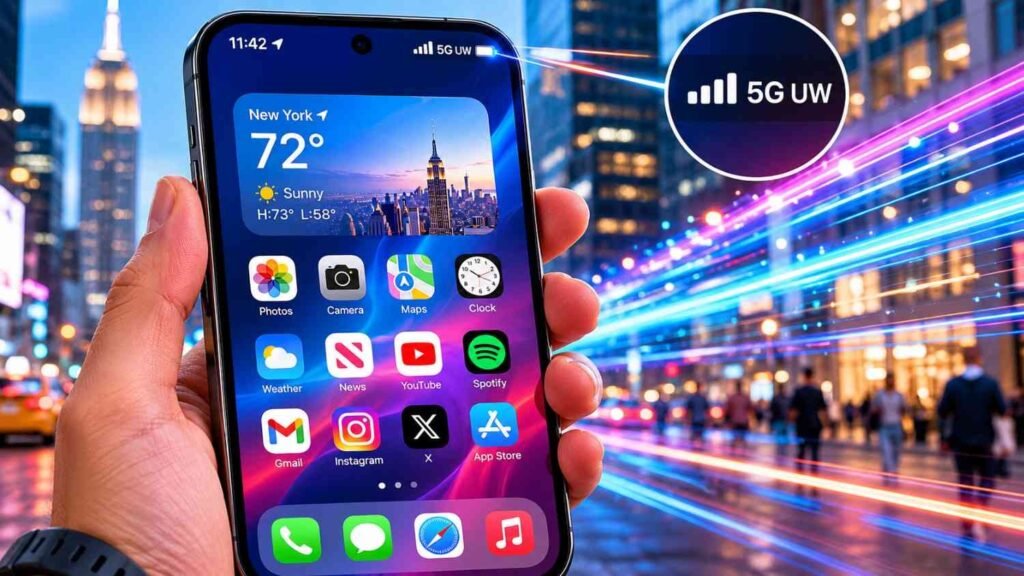

If you’ve noticed “5G UW” appearing on your phone and wondered what does mean, the short answer is simple: 5G UW stands for 5G Ultra Wideband, which is Verizon’s advanced version text of its 5G network.
When the 5G UW icon appears, your device is connected to a faster and more capable part of Verizon’s network. In most cases, this means quicker downloads, smoother streaming, and lower latency compared to standard 5G or LTE.
For example, downloading a large app that normally takes a few minutes on LTE may finish in seconds when you’re connected to 5G UW.
What Does 5G UW Stand For?
The term can look confusing at first, especially if you’ve never paid attention to network symbols before.
Here’s what it means:
- 5G = Fifth-generation cellular network
- UW = Ultra Wideband
Verizon uses the Ultra Wideband label to identify its highest-performing 5G service. Other carriers use different branding for similar technologies, which is why you may also come across terms like 5G UC or 5G+.
Many people assume UW is just another technical term, but it’s actually Verizon’s way of showing you’re connected to a faster tier of its network.
Why Does 5G UW Appear on My Phone?
The 5G UW symbol appears whenever your device connects to Verizon’s Ultra Wideband network.
It doesn’t necessarily stay on all the time because network conditions, location, and device compatibility all play a role.
Conditions Required to See 5G UW
To see the 5G UW icon, you generally need:
- A compatible 5G smartphone
- An active Verizon plan that supports Ultra Wideband access
- Coverage in a 5G UW service area
- A strong enough signal to connect
From what I’ve seen, people often assume something is wrong when the icon disappears. In reality, network indicators change constantly as you move around.
What Happens When You Leave a 5G UW Area?
When you leave an Ultra Wideband coverage zone, your phone automatically switches to standard 5G or LTE.
The process is seamless. Most users won’t even notice the transition unless they’re monitoring speed tests or downloading large files.
Is 5G UW Different From Regular 5G?
Yes, there is a noticeable difference between regular 5G and 5G UW.
The biggest differences are speed, network capacity, and latency.
5G vs 5G UW Comparison Table
| Feature | Standard 5G | 5G UW |
|---|---|---|
| Speed | Fast | Much Faster |
| Latency | Low | Lower |
| Network Capacity | Good | Excellent |
| Streaming Performance | Smooth | Smoother |
| Large Downloads | Quick | Extremely Quick |
| Coverage Area | Wider | More Limited |
Speed Differences
Standard 5G already offers solid performance, but 5G UW is designed for higher speeds.
A large movie download that takes a couple of minutes on regular 5G may complete significantly faster on Ultra Wideband.
Coverage Differences
One tradeoff is coverage.
Regular 5G reaches more locations, while Ultra Wideband is available in selected areas where Verizon has deployed its advanced network infrastructure.
Latency Differences
Latency refers to response time between your device and the network.
Lower latency can improve:
- Mobile gaming
- Video conferencing
- Cloud-based applications
- Real-time communication
For most everyday users, the difference is subtle. Gamers and power users tend to notice it more.
See Also: https://garminlive.com/what-does-szn-mean-in-texting-and-social-media-full-slang/
What Is Verizon 5G Ultra Wideband?
Verizon 5G Ultra Wideband is the company’s premium 5G experience.
Rather than offering one uniform 5G network everywhere, Verizon built different layers of coverage. Ultra Wideband represents the fastest and most advanced layer currently available.
Over the past few years, Verizon has expanded Ultra Wideband coverage substantially, making it available in more cities, suburbs, and public venues.
How Does 5G UW Work?
Ultra Wideband relies on advanced spectrum technologies that allow more data to move through the network efficiently.
The result is faster speeds and better performance in busy areas.
C-Band Spectrum
C-Band is now one of the most important parts of Verizon’s Ultra Wideband network.
It offers a practical balance between:
- Speed
- Coverage
- Reliability
This is the type of 5G UW connection most people encounter today.
mmWave Technology
mmWave is the ultra-fast version of 5G.
I’ve tested mmWave connections in crowded urban areas, and the speeds can be surprisingly fast. The downside is that the signal doesn’t travel as far and can be blocked more easily by obstacles.
You’ll often find mmWave coverage in:
- Stadiums
- Airports
- Downtown districts
- Large event venues
Why Verizon Uses Multiple Bands
No single frequency band is perfect.
By combining different spectrum bands, Verizon can provide broader coverage while still delivering high speeds where possible.
5G UW vs 5G UC vs 5G+
These terms often confuse users because they’re similar technologies with different carrier branding.
Verizon 5G UW
Verizon uses the Ultra Wideband label for its premium 5G network.
T-Mobile 5G UC
5G UC stands for Ultra Capacity.
T-Mobile uses this branding to identify its higher-performance 5G coverage.
AT&T 5G+
AT&T labels its advanced 5G service as 5G+.
Which One Is Better?
There isn’t a universal winner.
Performance depends on:
- Your location
- Network congestion
- Device compatibility
- Carrier infrastructure
Many people overlook this point and focus only on branding. Actual real-world performance matters far more than the label displayed on the screen.
Is 5G UW Faster Than LTE?
Yes, in most situations, 5G UW is significantly faster than LTE.
Some practical examples include:
- Faster app downloads
- Better video streaming quality
- Smoother video calls
- Reduced buffering
- Improved gaming performance
LTE remains reliable, but Ultra Wideband is built to handle much larger amounts of data.
See Also: https://garminlive.com/yfm-meaning-in-text-what-does-yfm-mean-in-chat-social-media-and-slang/
Does 5G UW Drain Battery Faster?
Battery consumption depends on several factors.
In earlier generations of 5G devices, battery drain was more noticeable. Modern smartphones have become much better at managing power usage.
You might see slightly increased battery usage if:
- You’re constantly connected to high-speed networks
- Signal conditions are weak
- Heavy downloading is occurring
For most users, the difference isn’t dramatic enough to be a daily concern.
Benefits of 5G UW
Ultra Wideband offers several practical advantages.
Faster Downloads
Large apps, games, and videos download much quicker.
Better Streaming Quality
High-resolution streaming becomes more consistent, especially during peak hours.
Improved Online Gaming
Lower latency can provide smoother gameplay and quicker response times.
More Reliable Crowded-Area Performance
Large events often overload traditional networks.
Ultra Wideband is designed to handle more simultaneous connections.
Enhanced Video Calls
Video meetings and calls generally experience fewer interruptions when network conditions are strong.
Potential Drawbacks of 5G UW
Despite its advantages, Ultra Wideband isn’t perfect.
Some limitations include:
- Availability varies by location
- Coverage may be weaker indoors
- Not all phones support it
- Performance depends on network deployment
From what I’ve observed, coverage remains the biggest limitation for most users.
How to Check if Your Phone Supports 5G UW
Not every 5G phone automatically supports Verizon’s Ultra Wideband network.
iPhone Users
Most recent iPhone models support Verizon 5G UW.
You can verify compatibility by checking:
- Device specifications
- Carrier settings
- Verizon account details
Android Users
Many flagship Android devices support Ultra Wideband connectivity.
Check:
- Manufacturer specifications
- Verizon compatibility lists
- Device network settings
Verizon Compatibility Check
The easiest option is checking directly through your Verizon account or support resources.
This removes any guesswork about compatibility.
Common Misconceptions About 5G UW
Several myths continue to circulate about Ultra Wideband technology.
5G UW Is Not the Same as UWB
This is probably the most common misunderstanding.
UWB (Ultra Wideband) technology used for device tracking and location services is completely different from Verizon’s 5G Ultra Wideband network branding.
The names sound similar, but they serve different purposes.
More Bars Do Not Always Mean Faster Speeds
Signal strength and network performance aren’t always identical.
A full signal doesn’t automatically guarantee the fastest possible speeds.
5G UW Does Not Appear Everywhere
Even if you have a compatible phone and plan, the icon only appears when you’re connected to an active Ultra Wideband coverage area.
See Also: https://garminlive.com/wtms-meaning-in-text-what-wtms-stands-for-and-how-to-use-it/
When Should You Use 5G UW?
If your device supports it, there’s generally no reason to avoid using Ultra Wideband.
It can be especially useful for:
- Remote workers
- Frequent travelers
- Mobile gamers
- Heavy streamers
- Content creators
For casual browsing and messaging, standard 5G is often more than sufficient. However, users who regularly consume large amounts of data usually benefit most from 5G UW.
Final Verdict: What Does 5G UW Mean in Text?
When you see 5G UW on your phone, it means you’re connected to Verizon’s 5G Ultra Wideband network.
In practical terms, that’s usually good news.
You’ll often experience faster speeds, lower latency, and better performance than standard 5G or LTE. While coverage isn’t available everywhere yet, the network continues expanding and becoming more accessible.
For most users, the icon simply indicates that their device is taking advantage of one of Verizon’s fastest mobile network technologies.
FAQs About 5G UW
What does 5G UW mean on an iPhone?
It means your iPhone is connected to Verizon’s Ultra Wideband 5G network.
What does 5G UW mean on Android?
It indicates that your Android phone is using Verizon’s advanced 5G Ultra Wideband service.
Is 5G UW better than regular 5G?
Generally, yes. It often delivers higher speeds and lower latency.
Why does my phone switch between 5G and 5G UW?
Your device automatically switches based on available coverage and signal quality.
Does 5G UW cost extra?
This depends on your Verizon plan. Some plans include Ultra Wideband access by default.
Is 5G UW available everywhere?
No. Coverage is expanding, but it’s not available in every location.
How fast is 5G UW compared to LTE?
In many situations, 5G UW can be several times faster than LTE.
Can I turn off 5G UW?
Yes. Most smartphones allow network preferences to be adjusted within settings.
Is 5G UW safe?
Yes. It operates under established wireless communication standards and regulations.
Why don’t I see 5G UW even with a 5G phone?
You may be outside a coverage area, using an unsupported plan, or have a device that doesn’t support Ultra Wideband frequencies.
What is the difference between 5G UW and UWB?
5G UW is Verizon’s network branding, while UWB is a separate wireless technology used for precise device location and tracking.
Which carrier uses 5G UW?
Verizon is the carrier that uses the 5G Ultra Wideband branding.
About The Author