
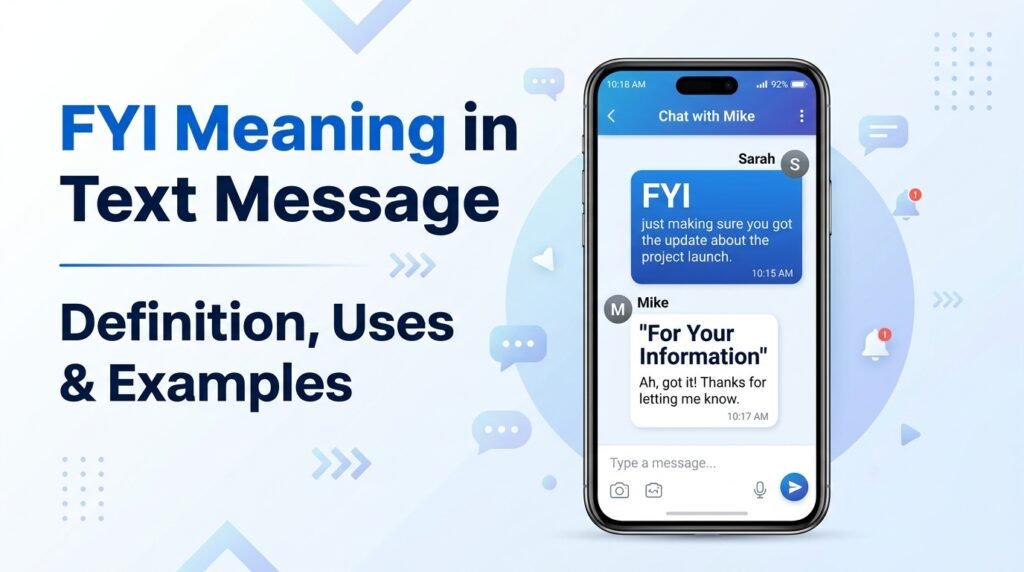

In text and other forms of digital communication, the acronym FYI comes up quite often as a fast way to send information without necessarily prompting the receiver to give back an instant reply. This is because FYI stands for ‘For Your Information’. FYI serves as a way of communicating information or giving useful context in personal and even professional settings via any platform whether through text messages, emails, social media, among others. If you have received an FYI through a text message and are unsure about its full meaning, then this article will guide you on all you need to know about FYI in text messaging.
What Does FYI Mean? (The Short Answer)
Quick Definition:
FYI = For Your Information
ToneNeutral
Response needed?Usually no
Used inTexts, email, Slack, DMs
FYI stands for “For Your Information.” That’s it. It’s an initialism each letter said individually used to pass along information without expecting the other person to do anything about it or necessarily reply.
If someone texts you “FYI, the restaurant changed its hours,” they’re not asking you a question. They’re just making sure you have that information before you show up to a locked door. Simple as that.
The tone is neutral by default. No pressure, no urgency. Just: here’s something you might want to know.
A Quick History of FYI: From Business Memos to Your WhatsApp Chat
FYI didn’t start with texting. It’s actually quite old.
The phrase “for your information” was common in American business memos as far back as the 1940s and 50s. Offices ran on paper correspondence, and slapping “FYI” at the top of an internal memo was a quick way to say: this doesn’t need your action, just your awareness.
From there it moved into fax messages, then into early email culture during the 1980s and 90s. By the time internet chat and SMS texting took off, FYI was already such a natural shorthand that it slid right in without anyone really deciding to adopt it.
Now you’ll see it everywhere iMessage, WhatsApp, Slack, Instagram DMs, comment sections. It traveled from a typewritten memo to a blue bubble on your phone screen over about seventy years, which honestly feels remarkable for a three-letter abbreviation.
Read More:https://garminlive.com/what-does-rn-mean-in-a-text/
How FYI Is Used in Text Messages: Real-World Examples
The abbreviation shows up in more contexts than people realize. Its usage shifts slightly depending on where you’re writing it a casual text to a friend reads differently from a Slack message at work, even if the letters are the same.
FYI in Casual Text Messages Between Friends
This is the most relaxed version of FYI. Among friends, it just means “heads up” breezy, low-pressure, nothing formal about it.
Example: Casual Text
FYI the game starts at 7 not 8, Jake moved it.
Oh nice, thanks for the heads up!
Example: Group Chat
FYI I won’t make it tonight, something came up.
No worries! We’ll catch you next time.
Notice how neither of these required an elaborate reply. That’s exactly the point. FYI signals: read this, note it, move on.
FYI in Work Messages and Slack
At work, FYI earns its keep. It’s genuinely useful in Slack and Teams because it lets colleagues know upfront that no response is needed which saves everyone the mental energy of figuring out whether they’re supposed to do something.
Example: Slack message
FYI: the client presentation moved to Thursday at 2pm. No changes to your slides needed.
👍
One thing worth noting: capitalization matters a little more than people think. “fyi” in lowercase reads casual. “FYI” in all caps can come across as slightly more emphatic sometimes even impatient depending on the rest of the message. From what I’ve seen, most professionals stick to the full caps version in emails and lowercase in Slack channels where the culture is more relaxed.
In email subject lines, FYI is standard and professional: FYI: Updated Project Timeline is immediately understood by anyone who receives business email regularly.
FYI on Social Media (Instagram, Twitter/X, TikTok)
Social media FYI has developed its own flavor. You’ll see it a lot in comment replies to correct misinformation: “FYI, that study has been debunked.” There’s often a slightly corrective edge to it in these contexts not always warm, but not aggressive either.
On TikTok especially, FYI in captions often has a self-aware, sometimes sarcastic undertone. “FYI nobody asked but here’s my opinion anyway.” That’s a different animal from the straightforward informational use which sets up something worth talking about next.
Read More: https://garminlive.com/what-does-rn-mean-in-a-text/
Can FYI Sound Rude? Understanding Tone in Text Messages
This is the question a lot of people are actually googling when they search “FYI meaning in text message.” Not the definition they want to know if the person who sent it to them was being dismissive.
Here’s the honest answer: FYI itself is neutral. What makes it land as rude or kind has almost nothing to do with the abbreviation and everything to do with what comes after it.
Sounds Harsh
“FYI, you made the wrong call on this.”
Is FYI, nobody agreed with your idea.”
“FYI, I’ve been waiting an hour.”
Sounds Helpful:
“FYI, the deadline got pushed to next Friday you’ve got more time!”
Is FYI, parking on that street is free after 6pm.”
“FYI, the meeting’s been moved just didn’t want you to show up at the wrong time.”
The pattern is pretty clear. When FYI precedes something critical, corrective, or negative, it comes across as cold like you’re making an announcement of someone’s failure rather than having a conversation with them. When it precedes something genuinely useful, it reads exactly as intended: a thoughtful heads-up.
If you’re about to send an FYI about something sensitive or potentially uncomfortable, drop the abbreviation entirely. A direct, warm opening will land better every time.
Many people overlook this, but adding a small buffer phrase softens FYI significantly: “Just so you know, FYI the meeting changed” or even just a “Hey FYI” before the message. Tiny addition, noticeably different reception.
FYI in Formal vs. Informal Settings: How Context Changes Everything
The same three letters work differently across contexts. Using FYI in a Slack message is not the same as dropping it into a letter to a bank or a university admissions office.
Using FYI in a Professional Email
In most professional environments, FYI is completely acceptable. It’s been part of business communication long enough that it doesn’t raise eyebrows especially in subject lines or in messages to colleagues you actually know.
Works well in email: Subject lines, forwarded threads (“FYI see below”), internal updates, team announcements where no action is required.
Where I’d be more careful: first-time emails to senior executives, formal correspondence with clients you’ve never met, or anything that needs to feel polished and deferential. In those situations, “For your reference,” “Please be advised,” or “I wanted to bring this to your attention” will always read as more considered.
It’s not that FYI is wrong it’s just that some situations call for a little more deliberateness than three letters convey.
FYI in Casual Texts, DMs, and Group Chats
In casual settings, there’s genuinely nothing to overthink here. FYI among friends, family, or close colleagues is natural and useful. It respects people’s time it signals “you don’t have to respond, I just wanted you to know.”
In group chats especially, FYI works well as a soft broadcast. “FYI I’ll be 10 minutes late” to a group thread is much cleaner than writing out “Hey everyone, just wanted to let you all know that I’m running a bit behind, so I’ll probably be there around 10 past.” Same information, zero wasted attention.
When a Guy or Girl Sends You FYI Is There a Hidden Meaning?
Short answer: no. FYI has no built-in romantic or flirtatious meaning.
When someone you’re interested in texts “FYI, I booked us a table at that place you mentioned,” the interesting part of that message is not the FYI it’s the fact that they remembered what you mentioned and made a reservation. The abbreviation is just delivery packaging.
That said, context matters. “FYI I think about you a lot” is unmistakably different from “FYI the restaurant is at 8pm” but again, it’s not FYI doing that work. It’s the content itself.
Don’t read meaning into FYI. Read meaning into what follows it. That’s where the actual intent lives.
There’s also a common worry that FYI from someone you’re in a conflict with is always aggressive. It isn’t or rather, it doesn’t have to be. If someone texts “FYI, I looked into it and you were right about the date,” that’s gracious, not loaded. The abbreviation itself is carrying the same neutral weight it always does.
How to Respond to an FYI Text (You Don’t Always Have To)
This trips people up more than it should. The whole point of FYI is that it doesn’t require a response. So if you received one and you’ve been staring at your phone wondering what to say back you don’t have to say anything.
A thumbs-up reaction, “Got it,” or “Thanks for the heads up” all work perfectly. If the FYI contains something that affects your plans, a brief acknowledgment makes sense. But a full response is rarely expected or needed.
| Scenario | Suggested Reply | Required? |
|---|---|---|
| Routine update (meeting moved, event changed) | “Got it, thanks!” or 👍 | Optional |
| Something that affects your schedule | “Good to know I’ll adjust my plans.” | Recommended |
| A potential issue flagged (“FYI the client pushed back”) | Acknowledge and engage: “Thanks for the heads up let’s talk through it.” | Yes |
| Casual info from a friend | React with an emoji or a brief reply if you feel like it | No |
| FYI forwarded email at work | No reply needed unless you have a question or comment | No |
FYI Alternatives: Other Ways to Say “For Your Information” in Texts
Sometimes FYI is exactly right. Other times the situation calls for something a little warmer, a little more urgent, or a little more formal. Here are the main alternatives and when each one actually makes sense.
Casual Text Alternatives (JSYK, Heads Up, Just So You Know)
- JSYK (Just So You Know) — Warmer and slightly softer than FYI. Good when delivering news that has some emotional weight. “JSYK, they cancelled the trip” lands gentler than “FYI, they cancelled the trip.”
- Heads up — More conversational, implies something requiring attention. Often used before mildly important news. “Heads up, the boss is in a mood today.”
- ICYMI (In Case You Missed It) — Used when sharing something the other person may not have seen yet, often a link, news item, or update. Very common on social media.
- FYA (For Your Action/Awareness) — Used in work contexts specifically. FYA implies the recipient might actually need to do something, unlike FYI which signals they don’t.
- BTW (By The Way) — A casual pivot, often mid-conversation. Less formal than FYI and often used for minor asides.
Professional Alternatives for Work Emails
If FYI feels too casual for the audience, these work well in business writing:
| Alternative Phrase | Tone | Best Used For |
|---|---|---|
| For your reference | Formal, polished | Attachments, documentation, archived info |
| Please be advised | Very formal, official | Legal notices, compliance updates, policy changes |
| Thought you might find this helpful | Warm, collegial | Sharing resources, articles, useful links |
| Just a note that… | Conversational, professional | Informal internal updates, soft reminders |
| I wanted to bring this to your attention | Respectful, attentive | Flagging potential issues, senior stakeholders |
Related Texting Acronyms You Should Know Alongside FYI
If FYI is in your vocabulary, these probably are too or they should be. They all live in the same informational/conversational space.
FWIW: For What It’s Worth used when sharing an opinion that may or may not be welcome
IMO / IMHO: In My Opinion / In My Humble Opinion flagging that what follows is a personal view
TBH: To Be Honest used before something candid or blunt
NGL: Not Gonna Lie similar to TBH, often used casually among younger users
IDK: I Don’t Know one of the most universal texting abbreviations
ICYMI: In Case You Missed It for sharing something they may not have seen
Read More: https://garminlive.com/tbh-meaning-in-text-messages-full-guide-and-explanation/
Common Mistakes People Make When Using FYI in Texts
For all its simplicity, FYI does get misused. These are the patterns I see come up most often.
Using FYI When You Actually Need a Response
FYI tells the reader: no action required. So if you actually need them to do something, confirm something, or get back to you FYI is the wrong opener. It will often result in silence on the other end, because the person genuinely thought no reply was needed.
If you need a response, use a direct ask: “Can you confirm by Friday?” or “Let me know what you think.” Clear beats subtle every time.
Using FYI to Deliver Criticism or Bad News
This is the big one. Pairing FYI with anything corrective, critical, or accusatory almost always reads as cold and detached. “FYI, that was the wrong approach” doesn’t communicate care it communicates distance.
If you’re delivering difficult feedback or bad news, drop the abbreviation and write the message the way you’d say it out loud to someone’s face. The FYI adds nothing except a layer of formality that feels like a shield.
Overusing FYI (When Every Message Starts With It)
When every message you send opens with FYI, it starts to read condescending like you’re constantly informing people of things they didn’t ask to be informed about. It loses its “neutral heads-up” quality and starts feeling like a verbal tic.
Use it when it genuinely fits the situation. When it doesn’t add clarity or signal anything useful about the nature of the message, just skip it and write normally.
FYI Quick Reference: Dos and Don’ts at a Glance
If you want a fast reference before you hit send:
| Do ✓ | Don’t ✗ |
|---|---|
| Use it to share neutral updates (“FYI, meeting moved to 3pm”) | Use it before criticism or blame (“FYI, you got that wrong”) |
| Use it in email subject lines for informational threads | Use it when you actually need a response or action |
| Use it in Slack or Teams for low-priority updates | Use it in very formal letters, academic writing, or legal documents |
| Use JSYK or “heads up” when delivering softer news | Open every single message with FYI it loses meaning quickly |
| Add a warm phrase after it when tone is uncertain | Assume the reader knows you’re being friendly context matters |
FAQs
What does FYI meaning in a text message?
The abbreviation provides information to an audience, which is not expecting a response or follow-up action on the part of the individual receiving the communication; and the communication is considered neutral with a low-pressure style.
Is FYI rude in a text?
The use of FYI in and of itself is not rude, but FYI for example, when the post below has a negative comment, criticism, complaint or other harmful content, may cause it to be interpreted in a cold or passive-aggressive manner. While FYI is a neutral term, any words following will shape how it will be interpreted based on the wording used.
Do I need to reply to an FYI text?
Generally speaking you do not need to reply back to an “FYI”, since the sender sent the message simply stating that they are sharing something that you might want to know but they are not expecting you to reply or take any further action after reading the message. If you do want to acknowledge receipt of the message, a short “Got It!” or a thumbs up in response is typically sufficient.
Can I use FYI in a professional email?
Sure, when communicating with other employees. In formal situations or for important emails – legal stuff, emails to a company’s top brass go with phrases like “For your reference” or “Please be advised.”
What are alternatives to FYI in text messages?
Some very common alternatives to FYI include JSYK (Just So You Know), “Heads Up”, ICYMI (In Case You Missed It), FYA (For Your Attention), and Conversely By the Way. Each one carries a slightly different meaning with words of more warmth attached to JSYK versus a more alert feel for Heads Up, or something could be overlooked for ICYMI.
Conclusion:
FYI is one of the most practical acronyms that can help us communicate efficiently. If used correctly, it saves time, gives clear instructions regarding the absence of any response required, and allows us to stay concise and clear.
The mistakes are easy to avoid no criticism should accompany the acronym, it shouldn’t be used to make inquiries, and overusage leads nowhere. Apart from that, FYI is an excellent means of communication that has proven itself through decades of digital communication evolution.
If next time you receive an FYI from someone and wonder whether to respond don’t think too hard and look at what follows.
About The Author