
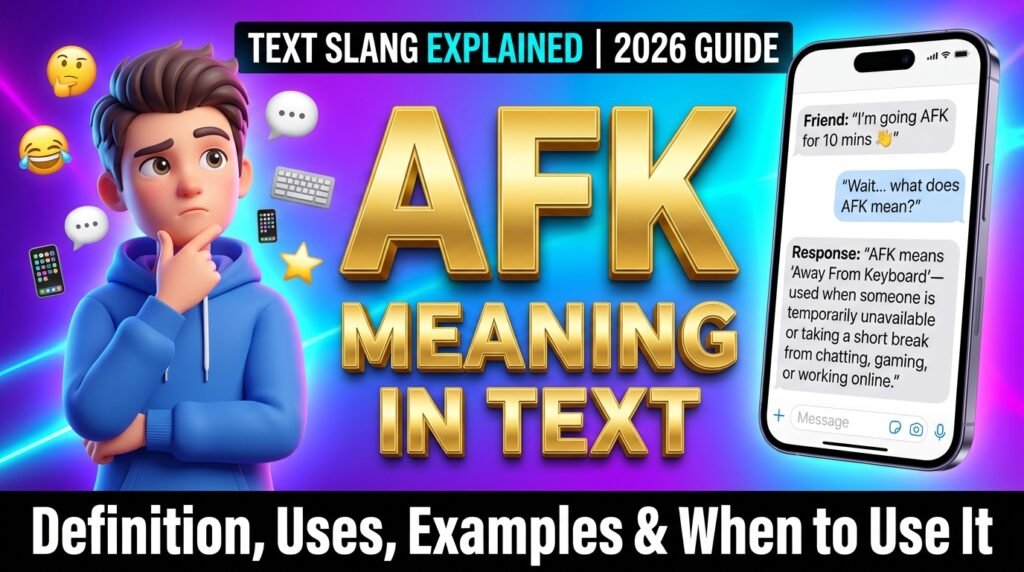

You may be chatting to someone on the phone, or having a gaming moment with your friends when suddenly the person you are communicating with stops responding. No goodbye will be given, and only a few minutes later you may get a message that says “sorry was AFK”. In case you are wondering what AFK meaning, you are not alone, as this means “Away From Keyboard” and it is one of the popular shortcuts used in text communication.
The following guide will give an overview on what does AFK meaning, the history of this term and its usage in text and chatting.
What Does AFK Mean?
AFK stands for “Away From Keyboard.”
It’s a way of telling someone you’re stepping away for a bit could be two minutes, could be two hours. The point is you’re not ignoring them, you’re just not physically at your device right now.
I’ve noticed people sometimes treat AFK like it means “I’m gone forever” or use it to just vanish from a conversation. That’s not really what it’s for. It’s meant to be informative a heads-up, not an excuse to disappear without context.
How to Pronounce and Write AFK (afk vs AFK vs Afk)
You say AFK by spelling it out “A-F-K” not as a single word like you would with “lol” or “yolo.”
As for capitalization, both “AFK” and “afk” are fine in casual texting or gaming chat. Lowercase feels more relaxed, uppercase reads slightly more deliberate, but honestly nobody’s going to correct you either way. No period needed after it, ever.
Where Did AFK Come From? (Origin & History)
This one surprises people. AFK isn’t a TikTok-era invention it’s actually older than most social media platforms by a couple of decades.
The term traces back to internet chat culture in the late 1980s and early 1990s. There’s a reference to it in a FidoNews bulletin from 1989, back when bulletin board systems were still a thing. From there, it became a staple of IRC (Internet Relay Chat) rooms throughout the ’90s, where stepping away without a heads-up could confuse an entire chatroom mid-conversation.
Then came the MMO boom games like EverQuest and later World of Warcraft where AFK became essential shorthand. If you were tanking a dungeon and needed to grab water, typing “afk” told your whole party what was going on before they wiped.
So no, it’s not a Gen Z term. If anything, Gen Z inherited it from IRC nerds and raid leaders.
Read More: https://garminlive.com/what-does-fw-mean-in-text-chat-slang-meaning-guide/
How Is AFK Used Today? (Modern Contexts)
AFK has quietly spread way beyond gaming. It started there, sure, but at this point it shows up pretty much anywhere people communicate digitally.
AFK in Gaming (Multiplayer & Online Games)
This is still its home turf. In team-based games League of Legends, WoW, Fortnite squads, whatever going AFK without warning can genuinely mess up a match. Teammates rely on everyone being present, so a quick “afk, brb” keeps things smooth.
AFK in Texting & Messaging Apps
Between friends on iMessage or WhatsApp, it’s just a casual way of explaining a delayed reply. Nothing formal about it more of an FYI than an announcement.
AFK on Discord, Slack & Workplace Chat
Discord actually has a built-in “AFK channel” feature that automatically moves idle voice chat users after a set time. That’s a detail most guides skip, but it’s genuinely useful to know if you’re in a lot of voice calls.
On Slack or Teams, people use it informally with coworkers they’re close with. I’d still be cautious using it with someone higher up more on that in a bit.
AFK on Social Media (Instagram, Twitter/X, TikTok)
You’ll see it in captions too something like “Going AFK this weekend, back Monday.” It’s become a casual way to announce a digital detox without sounding dramatic about it.
AFK Examples in Real Conversations
Seeing it in context usually makes it click faster than any definition does.
| Context | Example Message |
|---|---|
| Gaming | “brb, going afk for 5 mins, need water” |
| Texting a friend | “Sorry was AFK, just saw your message!” |
| Workplace Slack | “AFK for lunch, back by 1pm” |
| Social media caption | “AFK this weekend see you Monday” |
Notice the pattern it’s almost always paired with a reason or a return time. That’s what separates a clear, polite AFK from one that just leaves people hanging.
AFK vs. Similar Acronyms (Comparison Table)
People mix these up more than you’d expect, especially newer texters. They’re related, but not interchangeable.
| Acronym | Meaning | Typical Duration | Best Used When |
|---|---|---|---|
| AFK | Away From Keyboard | Minutes to hours | Stepping away temporarily |
| BRB | Be Right Back | A few minutes | Short, quick break |
| TTYL | Talk To You Later | Hours / end of chat | Wrapping up a conversation |
| GTG | Got To Go | Immediate | Leaving right now |
| IRL | In Real Life | N/A | Referring to offline life |
| AFAIK | As Far As I Know | N/A | Expressing uncertainty |
The easiest way I’ve found to remember the difference: BRB is a promise you’ll be right there, AFK is more of a status update. TTYL is closer to a goodbye than either of those.
When Should You Use AFK? (And When You Shouldn’t)
This is where a lot of people slip up, honestly.
Green light situations: gaming chat, texting friends, informal group chats, casual Slack or Discord messages with people you’re comfortable with.
Red light situations: client emails, formal reports, academic writing, or messaging someone senior at work you don’t know well. In those cases, it just reads as too casual even if nobody says anything, it can come across as unprofessional.
If you need a formal alternative, try:
- “I’ll be away from my desk for a bit”
- “I’m currently unavailable, will follow up shortly”
- “Stepping away back within the hour”
From what I’ve seen, using AFK in a client-facing email is one of those small things that quietly chips away at how professional you come across, even if the content is otherwise fine.
Read More: https://garminlive.com/bbw-meaning-in-text-2025-full-form-slang-uses-examples-hidden-meanings/
AFK Etiquette: How to Use It Politely
There’s an unwritten etiquette to this that most people pick up naturally, but it’s worth spelling out.
Give a reason when you can “AFK, dinner’s ready” lands better than a blank “afk.” Set an expectation too, even a rough one, like “back in 10.”
And avoid using it to dodge a conversation you don’t want to have. That’s not really what it’s for, and most people can tell the difference anyway.
When someone tells you they’re AFK, a simple “no worries, take your time” or “okay, ping me when you’re back” is all it takes. It’s not complicated, but it keeps things from feeling awkward.
AFK in Gaming: Special Rules & Consequences
Gaming is really the one place AFK carries actual consequences, not just social ones.
Most competitive games now have automatic AFK detection idle timers that flag you if you haven’t moved or acted in a while. Stay idle too long and you can get booted from the match entirely.
There’s also something called “AFK farming” where players exploit idle mechanics to rack up XP or resources without actively playing. Some games patch this out fast because it messes with balance; others quietly allow it.
And yes, repeated AFK behavior in ranked games like League of Legends or Valorant can lead to temporary bans or matchmaking penalties. It’s treated seriously because one AFK player can tank an entire match for four other people.
Common Mistakes People Make with AFK
A few mix-ups come up again and again.
AFK is not the same as AWOL. AWOL is a military term for someone who’s absent without permission much more serious, and not really interchangeable even as a joke in most contexts.
It’s also not the same as ghosting. Ghosting implies you’re gone for good with no explanation; AFK implies the opposite a temporary, communicated absence.
One more thing worth mentioning: leaning too hard on acronyms like this can actually make your messages harder to read, especially for people less familiar with internet slang. A little goes a long way.
Other Meanings of AFK (Less Common Uses)
Occasionally you’ll see AFK used differently outside gaming and chat things like “Away From Kitchen” as a joking variation, or as shorthand inside certain gaming clan names. These are rare and mostly used for humor, so don’t expect to run into them often.
Quick Recap: AFK Meaning Cheat Sheet
- AFK = Away From Keyboard
- Originated in 1990s IRC chatrooms, later adopted by MMO gamers
- Fine for casual texting, gaming, and informal chat
- Avoid it in formal emails or professional writing
- Different from BRB (shorter break) and TTYL (ending the chat)
- In games, staying AFK too long can get you kicked or penalized
FAQs:
What does AFK meaning in a text message? It means the person is stepping away from their phone or computer for a while and won’t be responding immediately.
What does AFK mean in gaming? It signals to teammates that a player has temporarily stepped away from the game, often used before a short break mid-match.
Is AFK rude to say? Not at all it’s actually considered polite, since it gives people a heads-up instead of leaving them wondering why you went quiet.
What’s the difference between AFK and BRB? AFK is more of a status update and can last longer, while BRB usually implies you’ll be back within a couple of minutes.
How do you spell out AFK? It’s pronounced letter by letter “A-F-K” not as a blended word.
Can you use AFK in a professional email? It’s best avoided in formal or client-facing writing. Stick to phrases like “away from my desk” instead.
What does it mean when someone goes AFK on Discord? Discord even has a built-in AFK channel that automatically moves idle voice chat users after a period of inactivity.
What is AFK farming in video games? It’s when players exploit idle-time mechanics to gain rewards or experience without actively playing something many games try to prevent.
Is AFK an acronym or an abbreviation? Technically it’s an initialism, since each letter is pronounced individually rather than forming a new pronounceable word.
What do you say back when someone says AFK? A simple “no worries, take your time” or “okay, let me know when you’re back” works fine in most cases.
At the end of the day, AFK is one of those small pieces of internet shorthand that’s stuck around because it’s genuinely useful it just works best when you know where the line is between casual and formal. Use it with friends and teammates, skip it with your boss, and you’ll be fine either way.
About The Author