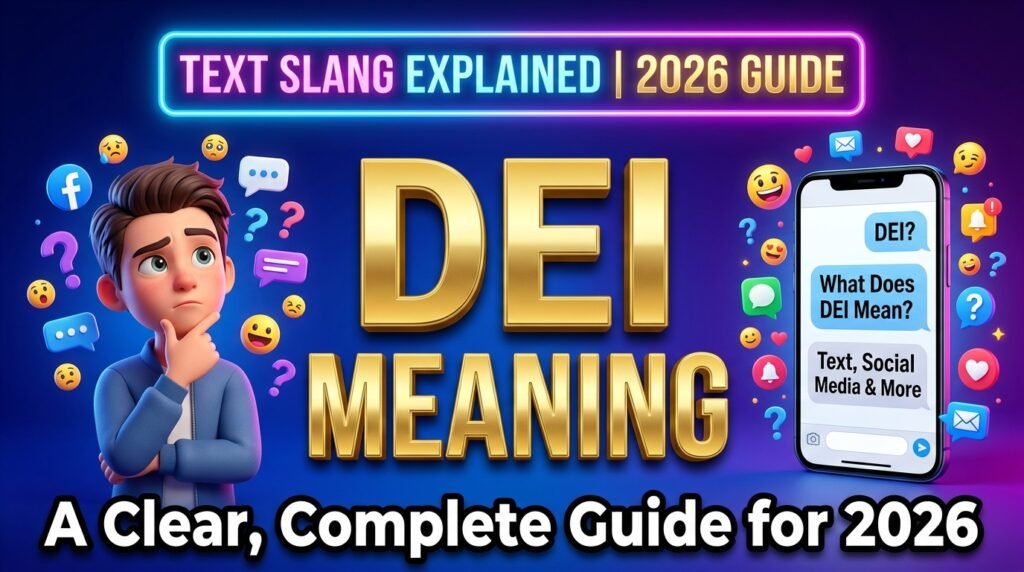

You received a Text message with “DEI” in it. Maybe a coworker dropped it in a group chat, your boss included it in an all-staff email, or you saw it flying around in a TikTok comment section, and you weren’t totally sure what it meant. That’s completely fair. It’s one of those terms that appear everywhere but rarely receive a proper explanation.
So let’s fix that.
DEI stands for Diversity, Equity, and Inclusion. It describes efforts to make sure people from all backgrounds are represented, treated fairly, and made to feel genuinely welcome whether in a workplace, a school, or an online community.
That’s the short answer. But if you’ve seen it in a text or on social media and want to understand what people actually mean when they use it, what the three parts really involve, and why it’s become such a loaded topic lately this guide covers all of it.
What Does DEI Stand For?
DEI is an acronym, not slang. Unlike LOL or BRB, it doesn’t change meaning depending on where you see it. Whether someone sends it in a WhatsApp message or uses it in a board meeting presentation, it always means the same thing.
Here’s a quick breakdown:
| Letter | Stands For | Core Idea |
|---|---|---|
| D | Diversity | Who is represented |
| E | Equity | Whether people have fair access and support |
| I | Inclusion | Whether people actually feel welcome and valued |
Each piece matters on its own but they work together. You can’t really have one without the others and call it a success. A team that’s diverse on paper but makes certain people feel invisible? That’s not inclusion. Let’s look at each part more closely.
Diversity What It Really Means
Diversity refers to the presence of real differences among people. That means race, gender, age, religion, disability, sexual orientation, socioeconomic background, and even how people think what some call cognitive diversity or neurodiversity.
Here’s a way to picture it: imagine a team where everyone went to the same school, grew up in the same neighborhood, and has more or less the same perspective on everything. Comfortable, sure. But also limited. When everyone thinks the same way, blind spots go unchallenged. That’s what a lack of diversity looks like in practice, and it tends to cost organizations more than they realize.
Diversity is fundamentally about who is in the room.
Equity: And Why It’s Not the Same as Equality
This is the one people trip over the most. Equity and equality sound almost identical, but they’re actually describing two different things.
Here’s the clearest way I’ve seen it explained: imagine three people of different heights trying to see a game over a tall fence. Giving everyone an identical box to stand on is equality same treatment for everyone. But the shortest person still can’t see. Equity means giving each person a box sized to what they actually need, so the outcome seeing the game becomes possible for everyone.
Equality = same treatment. Equity = fair outcomes.
It’s not about giving some people more than they deserve. It’s about recognizing that people start from different places, and identical treatment doesn’t always produce a fair result.
What Does DEI Mean in a Text Message or Online Chat?
This is the part most articles skip and it’s probably why you ended up here.
When you see DEI in a text, DM, comment section, or group chat, it means exactly what it means everywhere else: Diversity, Equity, and Inclusion. It’s not internet slang with a hidden meaning. It’s not a code word. just that the conversation has moved online, and the term moves with it.
Where you’ll commonly see DEI used in text or messaging:
- WhatsApp / iMessage coworkers sharing HR announcements, company DEI policies, or training invites
- LinkedIn DMs job seekers asking recruiters about a company’s culture; hiring managers discussing initiatives
- Instagram / TikTok DMs reactions to brand statements on representation or social issues
- X (Twitter) commentary on corporate DEI programs, often heated
- Reddit community threads debating DEI policy, hiring, and outcomes
To give you a better feel for how it actually shows up, here are a few realistic examples of how DEI lands in real conversations:
“Did you see the new DEI policy HR sent out? They’re finally doing pay equity audits.”
“That brand’s DEI statement felt pretty performative tbh no actual numbers, just vibes.”
“She heads up the DEI committee at her company, she’d be a great person to connect with.”
None of those require any decoding. The term carries its meaning with it. On TikTok especially, DEI appears heavily in workplace culture content videos about toxic work environments, representation gaps in leadership, and employees reacting to corporate announcements. The comment sections on those videos can get intense.
See More: https://garminlive.com/what-does-ngl-mean-in-text/
The History Behind DEI: Where Did It Come From?
Most people encounter DEI as if it appeared out of nowhere around 2020. It didn’t. The ideas behind it go back decades. What changed is how the conversation got labeled and how mainstream it became.
Here’s a rough timeline of how we got here:
1960s The Civil Rights Act of 1964 in the U.S. formally prohibited employment discrimination based on race, color, religion, sex, or national origin. This is the legal foundation everything else was eventually built on.
1970s–80s Affirmative action programs pushed organizations to actively recruit from underrepresented groups. The focus was mostly on numbers getting people in the door.
1990s “Diversity” started becoming a business concept, not just a legal obligation. Companies began running diversity training programs, with mixed results.
2000s Organizations started realizing that representation alone wasn’t solving the problem. People were being hired but not staying, not advancing, not thriving. “Inclusion” entered the conversation.
2010s “Equity” got added as it became clearer that you can’t just treat everyone the same and expect fair results. Systemic barriers in hiring, pay, promotion needed to be named and addressed.
2020 onward The term DEI went fully mainstream, accelerated by widespread social justice movements and major public reckonings around race and workplace culture. It’s now embedded in corporate strategy, public policy debates, and everyday conversations including your text messages.
DEI in the Workplace: What It Actually Looks Like Day-to-Day
This is where a lot of articles give you a nice-sounding list and stop there. I think it’s more useful to look at what DEI actually looks like from where you sit as an employee not just from HR’s perspective.
From what I’ve seen, the organizations that do this well don’t just announce a DEI commitment. They change specific behaviors and policies. Here are some concrete examples:
- Inclusive job descriptions Rewriting postings to remove coded language that unintentionally discourages certain applicants. (Words like “aggressive” or “rockstar” have documented effects on who applies.)
- Blind resume reviews Removing names and identifying details from applications to reduce unconscious bias in the screening process.
- Pay equity audits Actively reviewing compensation across roles to identify and close gaps by gender, race, or other factors.
- Employee Resource Groups (ERGs) Voluntary, employee-led groups organized around shared identities or experiences Women in Tech, LGBTQ+ Alliance, Black Professionals Network, and so on. These give people community and give leadership a direct line to underrepresented voices.
- Flexible holidays or cultural days Letting employees swap standard holidays for days that are personally meaningful to them.
- Accessibility accommodations Captioning software, screen readers, flexible hours, remote work options. Not as an afterthought, but built in from the start.
- Inclusive leadership training Teaching managers to notice their own assumptions and actively create space for quieter voices.
Here’s an example that sticks with me: imagine a deaf employee, Maya, starting a new job. DEI in action means her desk has captioning software already installed on Day 1 not because she had to fight for it, but because someone thought ahead. That’s the difference between having a policy and actually living one.
What Is DEI Training?
DEI training refers to structured programs designed to help employees and leaders understand unconscious bias, cultural differences, and what inclusive behavior actually looks like day-to-day.
It comes in different forms: workshops, e-learning modules, speaker series, mentorship programs, scenario-based exercises. Some companies do a single mandatory session and consider it done. That rarely works. The organizations that see real change treat DEI training as ongoing woven into how people are managed and evaluated, not a one-time checkbox.
It’s also worth noting that DEI training isn’t only relevant in healthcare or large corporations, where it tends to get the most coverage. Any team, in any industry, has some version of these dynamics. A small marketing agency, a nonprofit, a restaurant group same issues, different scale.
DEI in Schools and Education: What Students and Parents Should Know
DEI in an educational context works a bit differently than in a workplace, though the core principles are the same.
In schools and universities, DEI shows up as: making the curriculum represent a broader range of histories and perspectives, actively recruiting diverse faculty and staff, ensuring disability accommodations are genuinely accessible (not just technically available), and creating student resource groups where people can find community.
Universities are increasingly publishing formal DEI reports annual documents outlining goals, initiatives, and progress metrics. These can be useful for prospective students and parents who want to know whether the institution is actually doing the work or just making statements.
If you’re a parent, a few questions worth raising with your child’s school:
- How does the school handle bullying or exclusion related to race, disability, or sexual orientation?
- Are students with learning differences genuinely supported, or just technically accommodated?
- Does the curriculum reflect a range of cultural perspectives, or is it fairly narrow?
- Are there student groups where kids from different backgrounds can connect?
These aren’t controversial questions. They’re reasonable things to want to know.
DEI vs. DEIB vs. DEIA What’s the Difference?
This is something almost nobody explains well, and it’s worth a minute because you’ll start seeing these variations more often.
DEI is the standard framework Diversity, Equity, Inclusion. But over time, organizations have started adding letters as they realized DEI alone wasn’t capturing everything.
| Acronym | Full Form | What’s Added |
|---|---|---|
| DEI | Diversity, Equity, Inclusion | The core framework |
| DEIB | + Belonging | The emotional experience of inclusion |
| DEIA | + Accessibility | Physical, digital, and systemic barrier removal |
| JEDI | Justice, Equity, Diversity, Inclusion | Emphasis on structural justice |
DEIB adds “Belonging” and the distinction actually matters. You can technically include someone in a meeting and still make them feel like an outsider. Belonging is about whether people feel genuinely accepted, not just present. It’s the emotional outcome that good inclusion work is supposed to produce.
DEIA adds “Accessibility” specifically addressing barriers that affect people with disabilities. This includes physical spaces, assistive technology, captioning, screen readers, and how digital tools are designed. Accessibility was always implied in DEI, but adding the “A” makes it explicit.
Some organizations use IDEA (Inclusion, Diversity, Equity, Accessibility) or JEDI (Justice, Equity, Diversity, Inclusion), with Justice foregrounding the systemic and policy dimensions of the work. These aren’t universally adopted you’ll see them vary by sector and region.
Here’s the fixed section with an H3 added to break it past the 300-word threshold:
Common DEI Misconceptions: Let’s Clear These Up
DEI is one of those topics where a lot of confident opinions get built on shaky information. Here are the ones I hear most often and what’s actually accurate.
5 Things People Get Wrong About DEI
“DEI means hiring less-qualified candidates.” This is probably the most common objection, and it misunderstands what DEI actually does. DEI practices expand the talent pool and reduce bias in how candidates are evaluated. Research has repeatedly shown that hiring bias has historically excluded qualified people, not that DEI removes quality from the equation. The goal is to stop filtering people out based on irrelevant factors.
“DEI is just about race.” It covers gender, age, disability, religion, sexual orientation, neurodiversity, socioeconomic background, and more. Race gets the most public attention, particularly in the U.S. context, but the framework is broader than any single dimension.
“DEI only benefits minorities.” Inclusive workplaces tend to be better workplaces — period. Clearer communication, less groupthink, more psychological safety, fairer processes. These things benefit everyone, including people who don’t belong to any marginalized group.
“DEI is just a trend.” The three-letter acronym is relatively new. The underlying questions — who gets hired, who gets promoted, who feels safe to speak up, who gets paid fairly — are not new at all. They’ve existed as long as organizations have.
“Equity means guaranteed equal outcomes.” Equity is about providing fair access and removing unnecessary barriers. It doesn’t mean everyone ends up in the same place — it means the path isn’t unfairly blocked for some people and cleared for others.
Where the DEI Debate Stands Right Now
In 2024 and into 2025, a number of U.S. companies and government agencies scaled back or quietly renamed their DEI programs amid political pressure. This is real context worth knowing. The conversation around DEI is genuinely contested right now in legislatures, boardrooms, and yes, group chats. Understanding the actual substance of the arguments on both sides puts you in a much better position to form your own view.
Why DEI Matters The Real-World Impact (With Data)
Setting aside the political noise for a moment does any of this actually produce results?
The research that gets cited most often comes from McKinsey & Company, which has studied diversity and business performance across hundreds of companies for over a decade. Their consistent finding: companies with more diverse executive teams tend to outperform their less diverse peers financially by a meaningful margin. More recent analyses suggest the correlation has only strengthened.
Beyond financial performance:
- Decision quality improves when teams include people with different backgrounds and experiences. Diverse perspectives catch assumptions that homogeneous groups miss.
- Employee retention is higher in genuinely inclusive environments. People stay where they feel valued. Turnover is expensive losing a mid-level employee can cost a company 50–200% of that person’s annual salary in recruitment and training.
- Innovation is linked to cognitive diversity. Teams that think differently tend to generate more creative solutions and avoid the echo-chamber problem.
Why should this matter to you personally? Because most people spend a significant chunk of their lives at work. A more inclusive workplace is typically just a better place to be fewer politics, more trust, clearer communication. That benefits everyone in it, not just the people DEI is nominally designed to support.
If you want to evaluate a company’s DEI culture before accepting a job offer, keep reading the next section is for you.
See More:https://garminlive.com/what-does-smh-stand-for-in-texting-meaning-uses-hidden-contexts/
How to Respond When Someone Mentions DEI: Practical Conversation Guide
This might be the most practically useful part of this whole article. Knowing what DEI means is one thing. Knowing how to handle it when it comes up in real conversation is another.
At work: If your company announces DEI training and someone on your team asks what you think, you don’t have to have a polished answer. Saying “I’m curious to learn more” or “I hope it’s practical, not just theoretical” is completely legitimate. Genuine curiosity goes a long way.
In a text or DM: If someone sends you a DEI-related article or post, you don’t need to respond with an essay. A simple “interesting take I had no idea about the pay equity angle” shows you engaged with it. You’re not expected to be an expert.
In a job interview: If an interviewer asks “What does DEI mean to you?” this is genuinely a question about your values and self-awareness, not a quiz. A solid answer might look like: “To me, DEI means making sure that the way we hire, how we run meetings, and how decisions get made don’t systematically disadvantage certain people. I think diverse teams make better decisions, and I’ve seen that play out firsthand.” Specific and honest beats polished and vague.
If you disagree with a specific policy: That’s a legitimate thing to have opinions about. Raise it directly “I understand the goal, but I have some questions about how this particular approach works in practice” is a reasonable, professional way to engage. You’re more likely to be heard if you engage with the substance than if you dismiss the whole framework.
You genuinely don’t have to be an expert to participate in these conversations. Asking real questions and listening carefully is already doing the work
Quick DEI Glossary: Key Terms You’ll See Used With DEI
These are the terms that tend to come up alongside DEI especially in workplace training, HR communications, and online discussions. Short definitions, no jargon.
Unconscious Bias Mental shortcuts our brains use to make quick decisions. Everyone has them. The problem is when they influence hiring, promotions, or how we treat people without us realizing it.
Allyship Actively supporting people from groups you’re not part of. It’s less about what you identify as and more about what you do speaking up when you see someone dismissed, amplifying underrepresented voices, asking questions and listening.
Intersectionality A framework for understanding how multiple identities overlap and compound. A Black woman, for example, may face dynamics that are different from those faced by white women or Black men not just a combination, but something distinct. The term was coined by legal scholar Kimberlé Crenshaw.
Belonging The emotional experience of feeling genuinely accepted, not just present. It’s what inclusion is trying to produce.
Inclusive Language Word choices that don’t exclude people. “Team” instead of “guys.” “Partner” instead of assuming a spouse’s gender. “Accessible format” instead of “dumbed down.” Small shifts that add up.
Microaggressions Brief comments or actions that communicate bias, often unintentionally. “You speak such good English” directed at someone who speaks English natively. “Are you the diversity hire?” These things accumulate.
Psychological Safety The feeling that you can speak up, make mistakes, ask questions, or disagree without fear of being punished or humiliated. Teams with high psychological safety tend to be more creative and more effective.
Representation Whether people from different groups can see themselves in leadership, in media, in the curriculum, or in the room where decisions get made.
Frequently Asked Questions About DEI
What does DEI mean in a text message?
In a text message, DEI stands for Diversity, Equity, and Inclusion same as it does everywhere else. It’s not casual texting slang. It’s a formal term that’s simply migrated into everyday digital communication. You’ll see it in messages about work policies, company announcements, social media discussions, and anything touching on representation or fairness.
What does DEI stand for?
DEI stands for Diversity, Equity, and Inclusion. The three terms describe a framework for ensuring people from different backgrounds are represented in an organization, have fair access to opportunities, and feel genuinely welcomed not just tolerated.
What is the difference between diversity and inclusion?
Diversity is about who’s in the room. Inclusion is about what happens once they’re there whether people feel respected, heard, and safe to contribute. You can have diversity without inclusion. You can’t really have meaningful inclusion without diversity.
What does equity mean in DEI?
Equity means giving people what they need to have a genuinely fair opportunity not just identical treatment. A person using a wheelchair might need a ramp rather than stairs. A first-generation college student might need mentorship that a legacy admit doesn’t. Equity accounts for those differences.
Is DEI only for big companies?
Not at all. A team of five can practice DEI principles. Inclusive communication, fair decision-making, and genuine respect for different perspectives aren’t things you need a dedicated HR department to implement. They’re just practices. Scale adjusts; the fundamentals don’t.
What does DEI mean on social media?
On TikTok, Instagram, LinkedIn, X, and Reddit, DEI shows up in conversations about workplace culture, corporate accountability, brand diversity statements, and social movements. People use #DEI to share experiences, critique organizations, celebrate progress, and debate policy. The tone ranges from informational to very heated, depending on the platform and the news cycle.
Final Thoughts: Why Understanding DEI Matters Right Now
Whether you came here because someone texted you DEI and you weren’t sure what to make of it, or because your company is rolling out a new initiative and you wanted a clearer picture hopefully you have that now.
DEI isn’t just corporate vocabulary. At its core, it’s describing something pretty human: people want to be represented, treated fairly, and feel like they actually belong wherever they spend their time. Those aren’t radical ideas. The debates around how to achieve them are real and worth having. However, the underlying needs persist.
The language keeps evolving DEIB, DEIA, JEDI, and whatever comes next and the political landscape around these programs continues to shift. Staying informed, even at a basic level, means you’re better equipped to participate in those conversations without getting lost in the noise.
If you found this useful, share it with someone who had the same question. And if you’re digging into this topic for professional reasons whether you’re evaluating employers, building a team, or just trying to understand what your HR department keeps sending there’s a lot more worth exploring.
About The Author