
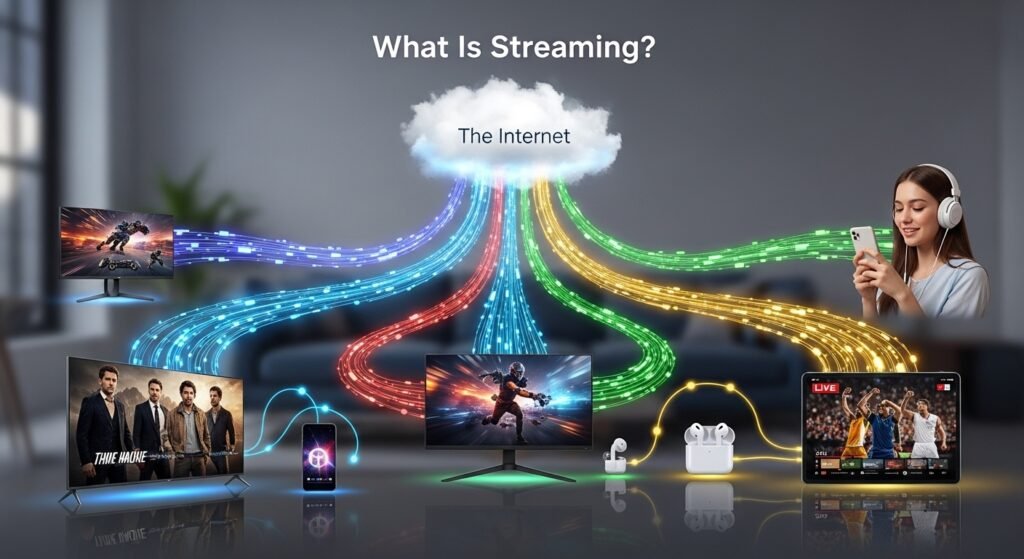

If you’ve ever watched a video on YouTube or a movie on Netflix without downloading it first, you’ve already used streaming.
In simple terms, streaming means playing audio or video directly over the internet without saving the full file to your device. It starts almost instantly and continues as data arrives.
From what I’ve seen, most people don’t even realize they’re streaming daily it’s just become part of how we consume content now. Whether it’s music, podcasts, or live sports, stream is everywhere.
How Streaming Works (Step-by-Step)
Streaming Process Explained
At its core, stream is just data moving from one place to another but in a smart, continuous way.
Here’s the basic process:
- Content is stored on a server (like a movie on Netflix)
- When you hit “play,” your device sends a request
- The server starts sending small chunks of data over the internet
- Your device plays those chunks in real time
I like to explain it using a water flow analogy. Instead of filling a whole tank (downloading), stream is like drinking water directly from a flowing tap. You don’t need to store everything you just use it as it comes.
Behind the scenes, things like compression, encoding, and content delivery networks (CDNs) help make this process fast and smooth.
Role of Internet Speed & Buffering
Internet speed plays a huge role in how well stream works. If your connection is slow, you’ll notice buffering that annoying pause while the video loads.
Here’s a rough idea of speed requirements:
- 3–5 Mbps: Standard quality
- 10–15 Mbps: HD streaming
- 25+ Mbps: 4K streaming
Buffering usually happens when your internet can’t keep up with the video quality. One simple tip that actually works: close background apps using your internet. Many people overlook this, but it can make a noticeable difference.
Don’t miss: https://garminlive.com/cloud-vs-local-storage-which-one-is-better-for-you-in-2026/
Types of Streaming
Live Streaming
Live stream is exactly what it sounds like content broadcast in real time.
Examples include:
- Live sports matches
- Gaming streams
- Social media live sessions
What makes live stream interesting is the lack of control. You can’t pause real life. From what I’ve seen, that “happening now” feeling is what keeps people hooked.
On-Demand Streaming
This is probably the most common type.
On-demand stream lets you watch content whenever you want. Movies, TV shows, and recorded videos fall into this category.
It’s the reason binge-watching exists. You don’t have to wait for schedules anymore you just pick something and hit play.
Audio Streaming
Audio stream focuses on music, podcasts, and online radio.
Apps like Spotify or Apple Music stream songs instantly without requiring downloads (unless you choose offline mode).
One thing I’ve noticed is how people have shifted from owning music to accessing it. Playlists replaced collections.
Cloud Streaming / Game Streaming
This one still surprises beginners.
Cloud streaming allows you to play games without installing them on your device. The game runs on a remote server, and you control it over the internet.
Services like Xbox Cloud Gaming or GeForce Now make this possible. It’s convenient, but it does require a stable and fast connection.
Popular Streaming Platforms
Here are some well-known platforms across different categories:
- YouTube (video streaming, free + ads)
- Netflix (movies and TV shows)
- Spotify (music streaming)
- Twitch (live stream, especially gaming)
There are many others, but these cover most everyday use cases.
Streaming vs Downloading
This is where beginners often get confused. Here’s a simple comparison:
| Feature | Streaming | Downloading |
|---|---|---|
| Access | Instant | Takes time |
| Storage | No space required | Uses device storage |
| Internet needed | Yes (mostly) | Not after download |
| Flexibility | Watch anytime (online) | Watch offline |
Personally, I prefer stream for convenience, but downloading still makes sense when traveling or dealing with unreliable internet.
Benefits of Streaming
Stream has grown so fast for a reason. It’s just easier.
Some clear advantages:
- Instant access to content
- No need for large storage space
- Works across multiple devices
- Flexible you can watch or listen anytime
From what I’ve seen, the biggest benefit is freedom. You’re not tied to a schedule or a device anymore.
Disadvantages of Streaming
It’s not perfect, though.
Some downsides include:
- Requires a stable internet connection
- Can consume a lot of data
- Buffering can interrupt the experience
- Subscription costs can add up
Many people ignore the cost factor. One subscription seems cheap, but multiple services quickly become expensive.
Don’t miss: https://garminlive.com/cursor-ai-acknowledges-kimi-k2-5-as-composer-2-core-model/
Tips for Better Streaming Experience
If you want smoother stream, these practical tips actually help:
- Use a high-speed internet connection
- Lower video quality if buffering occurs
- Close unused apps and tabs
- Use a wired connection for stability (if possible)
- Keep your apps and devices updated
I’ve personally found that even small tweaks like switching from Wi-Fi to mobile data or vice versa can fix stream issues instantly.
FAQs:
Is streaming free or paid?
Both. Some platforms offer free stream with ads, while others require subscriptions.
Does streaming use a lot of data?
Yes, especially for HD and 4K content. Video stream consumes much more data than audio.
Can I stream without internet?
Not really. However, some apps allow downloads for offline viewing.
What devices support streaming?
Almost all modern devices smart TVs, smartphones, tablets, and laptops support stream.
Is streaming legal?
Yes, as long as you use official and licensed platforms.
Final Thoughts:
Streaming has changed how we consume content, whether it’s movies, music, or games. It’s fast, flexible, and incredibly convenient.
From what I’ve observed, the trend is only growing. Internet speeds are improving, platforms are expanding, and more people are shifting away from traditional media.
If you’re just getting started, don’t overthink it. Open a platform, hit play, and you’ll understand the concept within minutes.
About The Author



Pingback: Boost Your Sales Instantly with This Powerful Bundling Trick - Garmin Live®
Pingback: Top 10 Fiber Internet Providers in America 2026 - Garmin Live®
Pingback: Spectrum Home Internet Review (2026): Pricing, Speed, Pros & Cons Explained - Garmin Live®