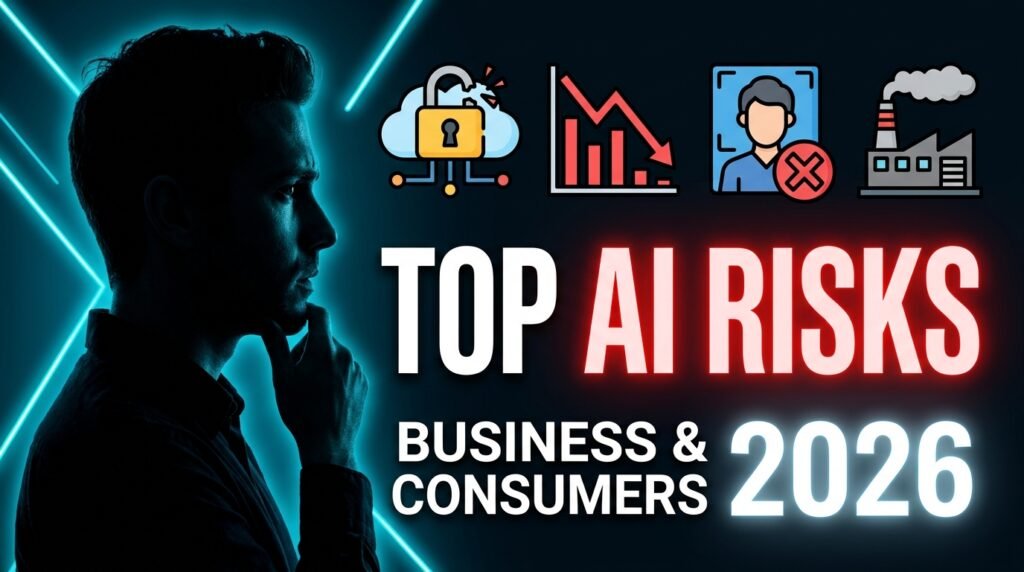

The conversation around AI has changed a lot over the past two years. Back in 2023 and 2024, most companies were focused on speed and productivity. By 2026, the bigger question is risks Businesses are now deeply dependent on AI systems for customer support, hiring, analytics, security, and even decision-making.
That shift has created a new set of problems. AI adoption risks are no longer theoretical. Companies are dealing with AI security issues, compliance pressure, and operational failures tied directly to automation. Consumers are facing AI scams, fake identities, and privacy concerns almost daily.
From what I’ve seen, many organizations rushed into AI implementation without building proper governance around it. That’s starting to show. The tools became smarter faster than the policies did.
The Biggest AI Risks Businesses Face in 2026
Enterprise AI risks now go far beyond simple software bugs. Businesses are connecting AI systems to internal workflows, customer data, and financial operations. When something breaks, the damage spreads quickly.
AI Cybersecurity Threats and Data Breaches
AI cybersecurity risks in 2026 are becoming harder to detect because attackers are also using AI. Phishing emails used to contain obvious grammar mistakes. Now they look almost identical to real internal communication.
One common example is AI-generated emails pretending to come from HR or finance departments. Employees click fake approval links because the language feels natural and personalized.
Prompt injection attacks are another growing issue. Attackers manipulate AI tools into exposing confidential information or bypassing restrictions. Businesses using AI agents without runtime security are especially vulnerable.
| AI Threat | Business Impact |
|---|---|
| AI phishing scams | Credential theft |
| Prompt injection attacks | Data exposure |
| AI-generated malware | System disruption |
| AI data leakage | Compliance violations |
Many people overlook this part: every AI tool increases the company’s attack surface.
AI Hallucinations and False Information
AI hallucinations still happen more often than vendors like to admit. Chatbots confidently provide inaccurate answers, fake statistics, or incorrect recommendations.
That becomes dangerous in customer service, healthcare, or legal support. I recently saw an example where an AI assistant gave a customer outdated refund policies that created a major support escalation.
Blind trust in AI outputs is one of the biggest AI businesses risks right now.
A simple rule helps:
- Treat AI-generated content as a draft, not a final answer.
- Fact-check anything tied to money, health, legal decisions, or customer communication.
AI Bias and Discriminatory Decisions
AI bias examples are showing up in hiring systems, loan approvals, and insurance assessments. The issue usually starts with biased training data.
An AI hiring tool trained mostly on historical company data may unintentionally favor certain demographics or reject qualified candidates unfairly. That creates both reputational damage and legal exposure.
Responsible AI practices now require human oversight. Fully automated decisions without transparency are becoming harder to defend legally.
AI Compliance and Legal Risks
AI regulations are evolving quickly across different countries. Businesses operating globally are struggling to keep up with AI laws in 2026.
Copyright confusion is another mess. Companies are asking:
- Who owns AI-generated content?
- Can AI-generated images violate copyrights?
- Is training data legally sourced?
Many legal teams are now creating internal AI governance policies just to reduce uncertainty.
A basic compliance checklist usually includes:
- Approved AI tools only
- Data handling policies
- Human review requirements
- AI audit documentation
- Employee usage guidelines
AI Agent Sprawl and Lack of Oversight
This problem doesn’t get enough attention.
Employees are building small AI workflows and bots without informing IT departments. Over time, businesses end up with dozens of unmanaged AI systems operating independently.
That creates operational chaos fast.
I’ve seen companies discover duplicate AI tools handling the same tasks with different rules and inconsistent outputs. Shadow AI tools are becoming the new shadow IT problem.
Internal AI governance frameworks are now essential, not optional.
See Also: https://garminlive.com/10-best-ai-tools-for-students-in-2026-free-paid/
Top AI Risks Consumers Should Know About
Consumers face different threats, but they’re just as serious.
AI Deepfakes and Identity Fraud
AI deepfakes are getting disturbingly realistic. Voice cloning scams have become one of the fastest-growing AI fraud risks.
Scammers now create fake emergency calls using cloned voices that sound almost identical to family members. A lot of people panic before verifying the situation.
A simple protection habit helps:
- Always verify urgent requests through another communication method.
- Use family-safe verification questions if needed.
AI-Powered Scams and Phishing Attacks
AI phishing emails and chatbot scams are harder to spot because they sound natural and context-aware.
Fake customer support chats are another growing issue. Some scammers build AI-powered chatbots that imitate banks, delivery companies, or ecommerce brands.
Never share:
- OTP codes
- Banking passwords
- Authentication links sent through random chats
The scams are becoming more personalized because AI can scrape public information quickly.
Privacy Risks From AI Apps and Devices
Smart assistants, AI mobile apps, and facial recognition systems collect enormous amounts of personal data.
Many consumers install AI apps without reviewing permissions. Some apps request microphone access, camera access, contacts, and location tracking unnecessarily.
AI privacy issues in 2026 are less about spying movies and more about constant background data collection.
Checking app permissions every few months is honestly one of the easiest security wins people ignore.
Overdependence on AI Tools
This one feels subtle but real.
People are starting to rely too heavily on AI for writing, research, decision-making, and problem-solving. Students use AI to complete assignments without understanding concepts. Employees depend on AI summaries instead of reading reports carefully.
AI productivity benefits are real, but overdependence reduces critical thinking over time.
Balanced AI usage matters more than people think.
Industry-Specific AI Risks in 2026
Healthcare AI Risks
Healthcare AI risks include diagnosis mistakes, biased treatment recommendations, and patient data exposure.
AI can assist doctors, but inaccurate AI outputs in healthcare can create serious consequences if humans stop double-checking results.
Financial AI Risks
Banks and fintech companies are heavily dependent on automated fraud detection and algorithmic systems.
The problem is that AI banking fraud is also increasing. Criminals now use AI to bypass fraud detection systems or generate convincing fake financial identities.
Ecommerce and Retail AI Risks
Fake AI-generated product reviews are everywhere now. Consumers often can’t tell whether reviews are written by real customers or automated systems.
AI pricing manipulation is another concern. Some retailers use AI-driven dynamic pricing aggressively, which can frustrate customers and damage trust.
How Businesses Can Reduce AI Risks
Create an AI Governance Policy
Every company using AI should have:
- Approved tool lists
- Employee AI rules
- Data-sharing restrictions
- Monitoring procedures
- Escalation processes
Without governance, AI adoption becomes chaotic quickly.
Train Employees on AI Safety
AI awareness programs matter just as much as cybersecurity training now.
Employees should learn:
- How AI phishing works
- Safe prompt practices
- Data privacy rules
- AI verification habits
Human mistakes still cause most AI-related security incidents.
Regularly Audit AI Systems
AI audits help businesses detect:
- Bias issues
- Security gaps
- Compliance violations
- Performance failures
Transparency and accountability will become standard expectations over the next few years.
How Consumers Can Stay Safe From AI Threats
Verify Before Trusting AI Content
Fact-check AI-generated information before sharing or acting on it.
Look for:
- Trusted sources
- Cross-verification
- Signs of manipulated media
Not every polished video or message is real anymore.
Use Strong Privacy and Security Settings
Consumers should:
- Enable multi-factor authentication
- Use password managers
- Limit unnecessary app permissions
- Keep devices updated regularly
Small habits reduce a surprising amount of AI fraud risk.
Read More: https://garminlive.com/how-to-create-high-converting-explainer-videos-with-ai-tools/
Future of AI Risk Management Beyond 2026
AI regulation 2026 is only the beginning. Governments are pushing for stronger transparency standards, AI accountability laws, and consumer protection requirements.
I think businesses that treat AI governance seriously now will have a major advantage later. The companies ignoring AI risk management are probably creating future legal and operational problems for themselves.
At the same time, AI itself is not the enemy. Most future AI concerns come from poor oversight, weak security, and irresponsible implementation.
The long-term goal should be trustworthy AI systems that improve productivity without sacrificing privacy, fairness, or human control.
FAQs
What are the biggest AI risks in 2026?
The biggest AI threats include cybersecurity attacks, AI hallucinations, deepfake scams, privacy violations, biased AI decisions, and compliance risks.
How can businesses protect themselves from AI risks?
Businesses should create AI governance frameworks, train employees on AI safety, monitor AI systems regularly, and implement strict data security controls.
Are AI deepfakes becoming more dangerous?
Yes. AI deepfakes and voice cloning scams are becoming far more realistic and harder to detect, especially in fraud and impersonation attacks.
Can AI replace human jobs completely?
AI will automate some tasks, but complete replacement is unlikely across most industries. Human oversight, creativity, and judgment still matter.
Is AI safe for consumers to use daily?
AI tools can be safe if used carefully. Consumers should verify information, protect personal data, avoid suspicious links, and use strong security settings.
About The Author