
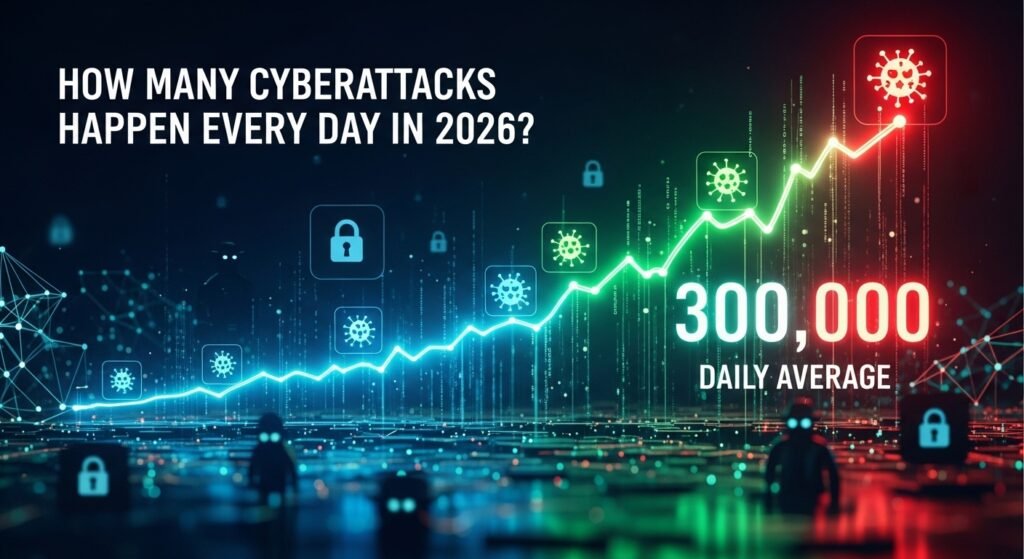

Every second, hackers are launching attacks and that’s not an exaggeration anymore. From what I’ve seen working with small businesses and reviewing security reports this year, cyberattacks in 2026 feel less like isolated incidents and more like a constant background noise of the internet. Whether it’s phishing emails, automated bot attacks, or ransomware attempts, the volume alone is what makes things worrying. What’s changed isn’t just the number of attacks it’s how easy they’ve become to execute. Tools that once required serious expertise are now accessible to almost anyone with basic technical knowledge. And this matters. Not just for large companies, but for individuals, freelancers, and even students. Online security concerns are no longer optional to think about.
How Many Cyberattacks Happen Every Day in 2026? (Latest Data)
Let’s get straight to the question: how many cyberattacks happen every day in 2026?
Based on multiple cybersecurity reports this year, estimates suggest over 30 to 40 million cyberattacks occur globally every single day. That includes everything from small automated login attempts to large-scale breaches.
Break that down, and it becomes more real:
- Millions of phishing emails sent daily
- Hundreds of thousands of malware infections
- Tens of thousands of ransomware attempts
Compared to just a few years ago, the increase in cyber threats is noticeable. Back in the early 2020s, daily attacks were already high but automation and AI have pushed those numbers even further.
Cyberattacks Per Second, Minute, and Hour
Here’s a simplified view of how fast things are happening:
| Time Frame | Estimated Cyberattacks |
|---|---|
| Per Second | ~400–500 attacks |
| Per Minute | ~25,000+ attacks |
| Per Hour | ~1.5 million attacks |
| Per Day | 30–40 million |
These aren’t all “successful” attacks, but they are real attempts. And honestly, even a tiny success rate is enough to cause massive damage globally.
Types of Cyberattacks Happening Daily
Not all cyberattacks look the same. Some are loud and disruptive, others are silent and slow.
Phishing Attacks
Phishing is still the most common attack type in 2026.
I still see fake emails pretending to be banks, delivery services, or even colleagues. Some are surprisingly convincing. Many people overlook small details like slightly misspelled domains.
Phishing scams now happen at an enormous scale millions of emails sent daily. And spear phishing (targeted attacks) has become more refined with AI-generated messages.
Ransomware Attacks
Ransomware hasn’t slowed down either.
Businesses are still prime targets. A typical scenario I’ve seen: a company employee clicks a malicious attachment, and within hours, files are encrypted and a payment demand appears.
Daily ransomware attacks are estimated in the tens of thousands globally. What’s worse is that attackers now often steal data before locking systems, adding pressure to pay.
Malware & Spyware
Malware infections happen quietly in the background.
Trojans, spyware, and malicious apps are often bundled with downloads or disguised as legitimate software. Once installed, they can track activity, steal credentials, or open backdoors.
From what I’ve observed, many users don’t even realize they’ve been infected until something breaks or money disappears.
DDoS Attacks
Distributed Denial of Service (DDoS) attacks are all about disruption.
These attacks flood websites or servers with traffic, causing downtime. They’re especially common against online businesses, gaming platforms, and financial services.
Daily DDoS attacks range in the thousands, and even short outages can lead to serious losses.
Who Is Being Targeted the Most?
Cyber threats worldwide don’t discriminate, but some groups are targeted more often.
Businesses & Enterprises
Businesses face constant pressure.
Small businesses, in particular, are more vulnerable than people think. Many assume hackers only go after large corporations, but smaller companies often have weaker security.
Common targets include:
- Customer databases
- Payment systems
- Internal communications
From experience, a single breach can disrupt operations for weeks.
Individuals & Personal Users
Individuals are targeted just as frequently just in different ways.
Think about:
- Social media account takeovers
- Password attacks
- Identity theft
Most personal cyberattacks happen through phishing or reused passwords. It sounds basic, but it’s still incredibly common.
Why Are Cyberattacks Increasing in 2026?
There isn’t just one reason it’s a mix of trends coming together.
- AI-powered attacks: Hackers now use AI to generate convincing messages and automate attacks
- More connected devices: IoT devices often lack proper security
- Remote work: Home networks are usually less secure than office environments
- Cybercrime marketplaces: Tools and data are easily available on the dark web
Many people underestimate how organized cybercrime has become. It’s not just individuals anymore it’s structured operations.
Impact of Daily Cyberattacks
The scale of cyberattacks has real consequences.
Financial Losses
Cybercrime is costing the global economy trillions annually in 2026.
Businesses lose money through:
- Ransom payments
- Downtime
- Recovery costs
Even individuals face direct financial damage through fraud or stolen accounts.
Data & Privacy Risks
Data breaches are one of the most damaging outcomes.
Personal information, business records, and even sensitive communications can be exposed. Once data is leaked, it’s almost impossible to fully recover control over it.
This is something many people don’t take seriously until it happens to them.
How to Protect Yourself from Daily Cyberattacks
You don’t need to be a cybersecurity expert to reduce your risk but you do need to be consistent.
Basic Security Practices
Start with the basics:
- Use strong, unique passwords
- Enable two-factor authentication
- Keep software updated
- Avoid clicking unknown links
- Use reliable antivirus tools
Simple steps, but surprisingly effective.
Advanced Protection Tips
For better protection:
- Use a VPN on public networks
- Consider endpoint security tools
- Monitor accounts for unusual activity
- Apply zero-trust principles where possible
From what I’ve seen, people who combine basic and advanced practices are far less likely to fall victim.
Future of Cyberattacks Beyond 2026
Looking ahead, cyber threats aren’t slowing down.
AI vs AI is becoming a real thing attackers using AI, defenders using AI. It’s an ongoing race.
There’s also growing concern about:
- Quantum computing risks
- More advanced social engineering
- Fully automated attack systems
The nature of cybercrime will keep evolving. That’s almost guaranteed.
FAQs
How many cyberattacks happen every day globally?
Roughly 30 to 40 million cyberattacks occur daily worldwide, including automated and targeted attempts.
What is the most common cyberattack in 2026?
Phishing remains the most common, largely due to its simplicity and effectiveness.
Are cyberattacks increasing every year?
Yes, cyberattacks have been increasing steadily, with noticeable spikes due to automation and AI tools.
Can small businesses be targeted daily?
Absolutely. In fact, many small businesses face daily attack attempts, often without realizing it.
How can individuals stay safe online?
Use strong passwords, enable two-factor authentication, avoid suspicious links, and keep systems updated.
Conclusion:
If there’s one thing to take away, it’s this: cyberattacks are happening constantly, at a scale most people underestimate. The number tens of millions per day isn’t just a statistic. It reflects how active and persistent cyber threats have become. Staying safe doesn’t require perfection, but it does require awareness and a bit of discipline. Small habits make a big difference over time.
Stay informed, stay protected.
About The Author