

When you’ve actually gotten text with VPN in it, you have to search out what does a VPN mean too! You’ve likely seen this, be it a text from someone or on social media, and received messages about it perhaps concerning internet privacy.
Often enough, “VPN” is used as a short form for Virtual Private Network, and this tool is meant for protecting your privacy online and securing your internet connection too. However, people can become confused when they see the acronym or term “VPN”, since many are new to tech and the terms related to internet security.
Here is a resource that explains it in layman’s terms, but also a resource that will give you plenty of info about “VPN”‘s usage as well as answer your questions about the many times that you have likely heard the term “use a VPN”. In short, once finished with this guide you will have had a plain-English way of understanding what “VPN” means, plus you will feel comfortable or confident when seeing the term or acronym “VPN” in texts, chat or social media.
What Does “VPN” Stand For? (The Short Answer)
VPN stands for Virtual Private Network. Three words, each one actually meaningful:
- Virtual There’s no physical cable connecting you to anything new. The connection exists digitally, as a layer on top of your regular internet.
- Private Your internet activity is shielded from outsiders. Your internet provider, network admins, even hackers on the same Wi-Fi none of them can see what you’re doing.
- Network It routes your device’s connection through a secure server before reaching the internet.
The classic analogy is a tunnel on a highway. Other cars on the highway (think: hackers, trackers, your ISP) know the highway exists, but they can’t see what’s inside your tunnel. You’re moving through the same road just privately.
That tunnel analogy is actually pretty accurate. How it works behind the scenes is what we’ll cover next.
Why Are People Talking About VPNs in Texts and Group Chats?
From what I’ve seen, the topic really picked up momentum around 2019-2020 remote work exploded, data breach headlines became weekly news, and people started actually paying attention to their online privacy. Before that, VPNs were mostly a “corporate IT thing.”
Now? Your non-tech uncle might mention one. You’ll see it in gaming Discord servers, travel Facebook groups, news articles. Here’s where you’re most likely to see the URL meaning pop up in a text or conversation:
- A travel group chat where someone says “enable your VPN when you land, hotel Wi-Fi isn’t safe”
- A streaming group where people discuss accessing shows not available in their country
- A data breach news thread where someone recommends VPNs for basic protection
- A friend who works in IT who casually drops it like everyone already knows what it means (they really need to stop doing that)
- A WhatsApp group in a country with restricted internet access where VPNs are a daily necessity
The reason it’s showing up everywhere is pretty simple: people’s awareness of online privacy has grown a lot. And honestly, that’s a good thing. If someone texted you “just use a VPN,” they’re genuinely trying to help they’re not showing off.
How Does a VPN Actually Work? (No Tech Degree Required)
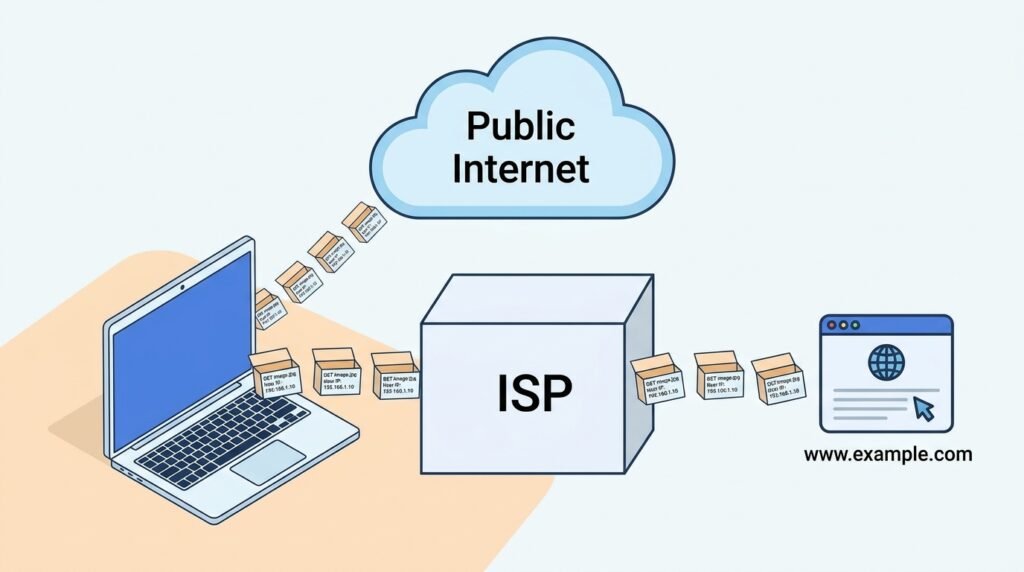
Here’s the process broken down into plain steps:
- You open your VPN app and hit connect
- Your device sends your internet traffic through an encrypted tunnel to a VPN server
- That server sends your request out to the website or app you’re using
- The website sees the VPN server’s IP address and location not yours
- The response travels back through the same encrypted tunnel to your device
Think of it like sending a letter in a locked box. Your postal service (that’s your ISP your internet provider) can see a box is being delivered, but they can’t open it or read what’s inside.
The two things that make this work are your IP address and encryption. Let me explain both briefly.
What Is an IP Address and Why Does It Matter?
Your IP address is basically your home address on the internet. Every device connected to the internet has one, and websites use it to know where to send the information you request.
The problem is, your IP address also reveals your approximate location and is used by advertisers, data brokers, and potentially bad actors to track and identify you. Most people don’t realize just how much gets attached to that little string of numbers.
When you use a VPN, your real IP is replaced with the VPN server’s IP. If that server is in Germany, websites think you’re in Germany. Your actual location stays private.
What Is Encryption and Why Should You Care?
Encryption is the process of scrambling your data into unreadable gibberish and it can only be unscrambled by someone with the right key. Most reputable VPNs use something called AES-256 encryption, which is the same standard used by banks and government agencies.
You don’t need to understand the math behind it. What matters is this: if someone intercepts your data while you’re using a good VPN, what they get is completely useless to them. It’s just noise.
What Does a VPN Do For You? (Real Benefits, Real Situations)
Rather than just listing features, let me walk through actual situations where a VPN makes a real difference. Because the abstract “protects your privacy” answer doesn’t really stick until you picture a scenario you relate to.
You’re on Public Wi-Fi at a Coffee Shop
Public Wi-Fi is genuinely risky. Anyone on the same network with basic tools can intercept the unencrypted traffic of other users. This is called a “man-in-the-middle” attack, and it’s not as rare as people assume.
With a VPN on, everything leaving your device is encrypted. Even if someone intercepts it, they get nothing readable. This alone is a solid reason to use one if you work remotely from cafes or airports.
You’re Traveling and Your Favorite App Won’t Work
Ever tried to open a streaming app while traveling abroad and gotten a “not available in your region” message? That’s geo-blocking content licensing means different content libraries in different countries.
A VPN lets you connect to a server back home. The streaming service thinks you’re at home, and everything loads normally. I’ve personally used this while traveling and it works reliably with most major services.
You Don’t Want Your ISP Watching Everything You Do
Many people don’t realize that in several countries including the US internet service providers can legally collect and sell your browsing history to advertisers. You’re paying for your internet connection, and they’re also monetizing your data.
A VPN encrypts your traffic so your ISP sees almost nothing. They know you’re connected to a VPN server, but that’s it. What sites you visit, what you search for all of that is hidden.
You Work from Home and Need to Access Company Files
This is actually the original use case for VPNs. Companies set them up so employees can securely connect to internal servers and files from outside the office.
If your company gave you VPN credentials, this is exactly what it’s for. It creates a secure tunnel between your laptop at home and the company’s network.
You Want to Stop Targeted Ads from Following You
You’ve experienced this you search for something once and suddenly it’s everywhere. A VPN reduces (not eliminates, but reduces) how easily advertisers can link your activity across sites.
Pair it with a privacy-focused browser and you cut down the creepy follow-me ads significantly. Not a perfect solution, but a meaningful one.
What a VPN Does NOT Do (Common Myths Busted)
Many people overlook this part, but it’s important. A VPN is a powerful tool with real limits. Getting these expectations wrong leads to a false sense of security.
| Myth | Reality |
|---|---|
| “A VPN makes me 100% anonymous” | It reduces traceability but doesn’t eliminate it. Websites can still track you via cookies, logged-in accounts, and browser fingerprinting. |
| “VPN protects me from viruses and malware” | No. A VPN encrypts your connection it doesn’t scan files or block malicious downloads. You still need antivirus for that. |
| “Free VPNs are just as good as paid ones” | Often not. Many free VPNs log your activity and sell it. That’s the opposite of what you want. |
| “VPNs are illegal” | Legal in most countries. Restrictions exist in a few places, but using one to browse normally is fine almost everywhere. |
| “VPN will slow my internet to a crawl” | Older or cheap VPNs do this. Modern premium VPNs cause barely noticeable slowdowns for regular browsing. |
The anonymity myth is the one I see cause the most problems. People assume a VPN = invisible. It doesn’t. If you’re logged into Google while using a VPN, Google still knows who you are. The VPN hides you from your ISP and network snoopers not from services you’re actively signed into.
Types of VPNs Which One Are People Probably Talking About?
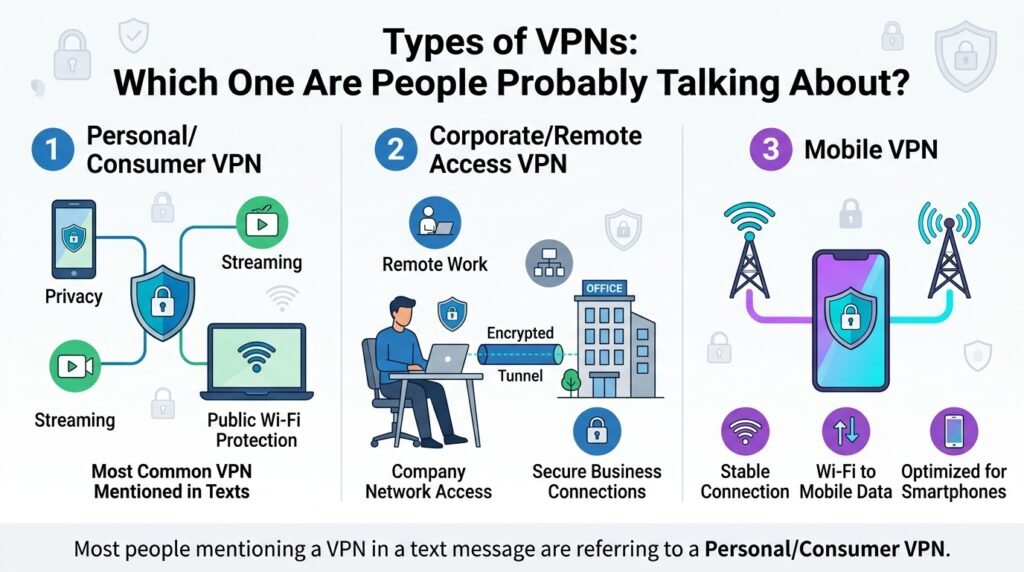
When someone mentions a VPN in a text message, they’re almost certainly talking about a personal or consumer VPN. But there are a few types worth knowing.
Personal/Consumer VPN (The One Most People Mean)
This is what you download as an app. NordVPN, Surfshark, ExpressVPN, ProtonVPN these are all consumer VPNs. You pay a monthly fee (or use a free tier), install the app, and tap connect. That’s the whole process.
These are designed for individuals who want privacy, streaming access, or public Wi-Fi protection.
Corporate/Remote Access VPN
This is what companies use so employees can securely access internal systems from anywhere. You may already use one without thinking of it as a “VPN” if your company gave you credentials to connect to their servers remotely, that’s a corporate VPN.
Mobile VPN
Mobile VPNs are specifically optimized for smartphones. They’re designed to maintain a stable encrypted connection even when your phone switches between Wi-Fi and mobile data. Most major consumer VPN apps function as mobile VPNs by default these days.
If most of your internet use is on your phone which for most people it is a mobile-first VPN matters.
Is Using a VPN Legal? (What You Should Know)
The short answer: yes, in most of the world, using a VPN is completely legal.
The slightly longer answer depends on where you are:
- Fully legal and unrestricted: USA, UK, EU, Canada, Australia, India, Pakistan, and most of the world
- Restricted to government-approved VPNs: UAE, Russia, China (you can use VPNs, but they must be licensed by the government which largely defeats the privacy purpose)
- Effectively banned: North Korea, Belarus, Turkmenistan
One important note: a VPN being legal doesn’t mean you can use it to do illegal things. If what you’re doing online is against the law, the VPN doesn’t protect you from the legal consequences. It’s a privacy tool, not a get-out-of-jail-free card.
If you’re unsure about the rules in your specific country, a quick search for “[your country] + VPN laws 2024” will give you current, accurate information.
Free VPN vs. Paid VPN What’s Actually Worth It?
This question comes up a lot and the answer isn’t black and white. Free VPNs aren’t all bad, and paid ones aren’t all great but there are real trade-offs.
| Feature | Free VPN | Paid VPN |
|---|---|---|
| Cost | $0 (but often a data cost) | $2–$15/month |
| Privacy | May log and sell your data | Audited no-logs policies |
| Speed | Slower, often throttled | Fast, optimized servers |
| Data limit | Usually capped (500MB–10GB/month) | Unlimited |
| Server locations | Very limited | 50–100+ countries |
| Ads | Frequent | None |
| Support | Minimal | 24/7 live chat |
The important thing with free VPNs is knowing how they make money. If they’re not charging you, something else is often funding the service and that something is sometimes your browsing data.
That said, ProtonVPN’s free tier is a genuine exception. It has a verified no-logs policy, no data caps, and no ads. Windscribe and TunnelBear also offer respectable free tiers with sensible limits.
Paid VPNs on a 2-year plan often cost less than $3–4 a month. If you use the internet daily and value your privacy at all, that’s a reasonable trade-off. But if you just want to test things out, start with ProtonVPN’s free tier and see if you actually use it.
How to Set Up and Use a VPN (Even If You’re Not Tech-Savvy)
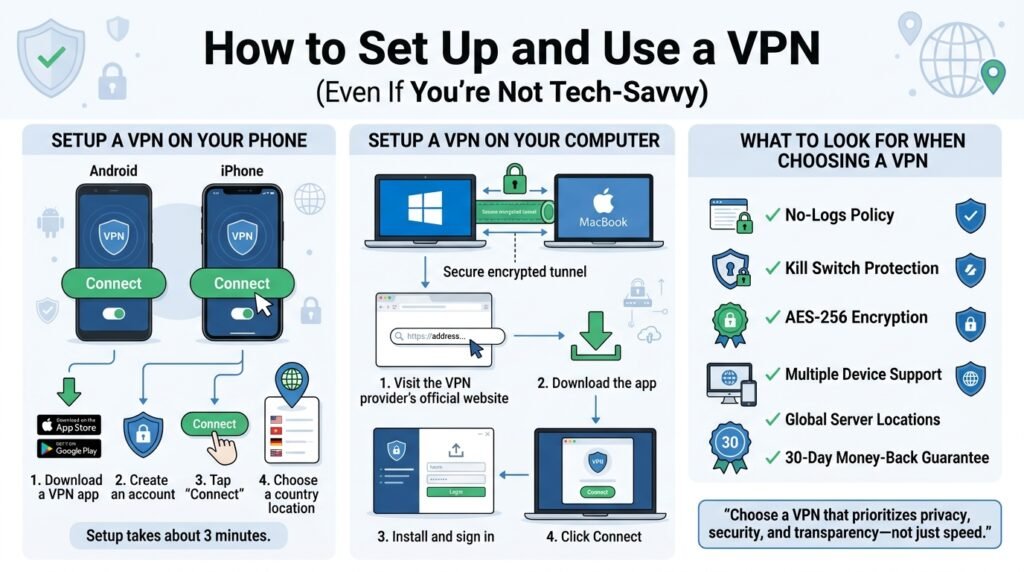
This is where people often assume it’s complicated. It really isn’t.
On Your Phone (Android or iPhone)
- Open your app store and search for a VPN (ProtonVPN, NordVPN, and Surfshark are all well-reviewed)
- Download the app and create an account
- Open the app and tap “Connect” you’re done
- Want to connect to a specific country? Tap the location menu and pick one
The whole setup takes about three minutes. Your phone may ask for a VPN configuration permission this is normal, just allow it.
On Your Computer (Windows or Mac)
- Go to your chosen VPN provider’s website directly (don’t search for random downloads)
- Download the official app for your operating system
- Install it, sign in, and click “Connect”
- Optional: explore settings like the kill switch (cuts your internet if the VPN drops, preventing accidental exposure) or protocol options
What to Look for When Choosing a VPN
Not all VPNs are equally trustworthy. Here’s what actually matters:
- No-logs policy and ideally, one that’s been verified by an independent security audit, not just a promise
- Kill switch cuts your internet if the VPN connection drops unexpectedly
- AES-256 encryption the current industry standard
- Number of simultaneous devices most plans allow 5–10
- Server locations more options = more flexibility
- Refund policy reputable providers offer 30-day money-back guarantees, which tells you they’re confident in the product
Read More: https://garminlive.com/imo-meaning-in-text/
VPN vs. Other Privacy Tools What’s the Difference?
A VPN is one tool among several. Knowing where it fits helps you decide whether it’s what you actually need.
| Tool | What It Does | Best For | Limitation |
|---|---|---|---|
| VPN | Encrypts all traffic and hides your IP | All-round privacy and security | Minor speed reduction; usually costs money |
| Proxy | Hides your IP but no encryption | Quick location switching | Not secure no encryption at all |
| Tor Browser | Routes traffic through multiple nodes for deep anonymity | Maximum anonymity | Very slow; not practical for streaming or everyday use |
| Incognito Mode | Hides browsing from your own device’s history | Shared computers | Doesn’t hide you from your ISP, employer, or websites |
| DNS-over-HTTPS | Encrypts only your DNS queries | Partial privacy boost | Doesn’t protect the rest of your browsing activity |
A common misunderstanding is that incognito mode gives you privacy online. It doesn’t it just doesn’t save your history to the device. Your ISP, the websites you visit, and anyone monitoring your network can still see everything.
For most everyday users, a VPN hits the right balance: genuinely protective, easy to use, affordable, and fast enough that you won’t notice it running.
FAQs
What does VPN mean in a text message?
When someone mentions a VPN in a text or chat, they mean a Virtual Private Network a tool that encrypts your internet connection and hides your online activity. They’re most likely recommending you use one for privacy, security, or to access content that’s restricted in your region. It’s not slang and it doesn’t have an alternate meaning in texting contexts.
Is VPN slang for something else?
No. In basically every context you’ll encounter it tech forums, messaging apps, news articles VPN means Virtual Private Network. It’s a technical abbreviation, not internet slang with hidden meanings.
Do I need a VPN on my phone?
If you regularly connect to public Wi-Fi, travel internationally, or want to keep your mobile carrier from logging your browsing activity then yes, a VPN on your phone is worth having. Most major providers have clean, easy-to-use apps for both Android and iPhone.
Can my phone carrier see what I do if I use a VPN?
Your carrier can see that you’re connected to a VPN server. But they cannot see what websites you visit or what data you’re sending that traffic is encrypted before it leaves your device. From their view, it’s just a tunnel they can’t open.
Does a VPN use a lot of data or battery?
A VPN adds roughly 5–15% overhead to your data usage because of the encryption process. The battery impact is real but minor with well-optimized apps. For everyday use, most people don’t notice either one.
What’s the safest free VPN?
ProtonVPN’s free tier. It has an independently audited no-logs policy, no data caps, and no ads. Windscribe and TunnelBear are solid second options with generous free tiers. Avoid obscure free VPNs you’ve never heard of many of them monetize your data.
Can kids use a VPN?
A VPN will work on any device, including a child’s. But parents should know that VPNs can bypass parental controls and content filters. Rather than just restricting it, it’s worth having a direct conversation about what a VPN is and responsible internet use it’s a more effective long-term approach anyway.
Is it safe to always leave a VPN on?
Yes keeping your VPN running continuously is safe and is generally the recommended approach for consistent protection. The only time you might want to turn it off is if something requires a local network connection (like printing to a home printer or using certain smart home devices). For regular internet browsing, leaving it on is the better call.
Quick Recap: What Does VPN Mean and Should You Use One?
So now you know what VPN means when someone texts it to you. It’s not jargon, it’s not slang, and it’s not as complicated as it sounds.
A VPN (Virtual Private Network) encrypts your internet connection and hides your IP address. That’s the core of it. Everything else streaming access, public Wi-Fi safety, ISP tracking prevention is a result of those two things.
Should you get one? Here’s a simple way to think about it:
- ✅ You use public Wi-Fi regularly → Get a VPN
- ✅ You travel internationally → Get a VPN
- ✅ You want your ISP out of your browsing history → Get a VPN
- ✅ You care about your privacy in a general sense → Get a VPN
- ⏳ You only browse on a trusted home network and genuinely have no privacy concerns → VPN is optional, but still doesn’t hurt
Start with ProtonVPN’s free tier if you want to see how it feels before committing to anything. If you use it daily for a week and find it useful, a paid plan is worth considering.
Have a question about VPNs that wasn’t covered here? Drop it in the comments happy to answer.
About The Author