What Does the Skull Emoji 💀 Mean in Text? Complete 2026 Guide
You send a funny story to your friend. They reply with a single 💀. No words. Just a skull. If you’ve ever wondered what the skull emoji mean in text, you’re not alone and the answer might surprise you.
Are they okay? Are you okay? Did something go terribly wrong?
Relax nothing bad happened. If anything, you just made their day.
The answer has changed dramatically over the past few years, and if you’re not up to speed, you’re probably misreading half your conversations. This guide covers everything: what 💀 actually means today, how it’s used across different platforms, the difference between 💀 and ☠️ (yes, they’re different), how to reply when someone sends it, and when you probably shouldn’t use it at all.
What Does 💀 Mean in Text Right Now?
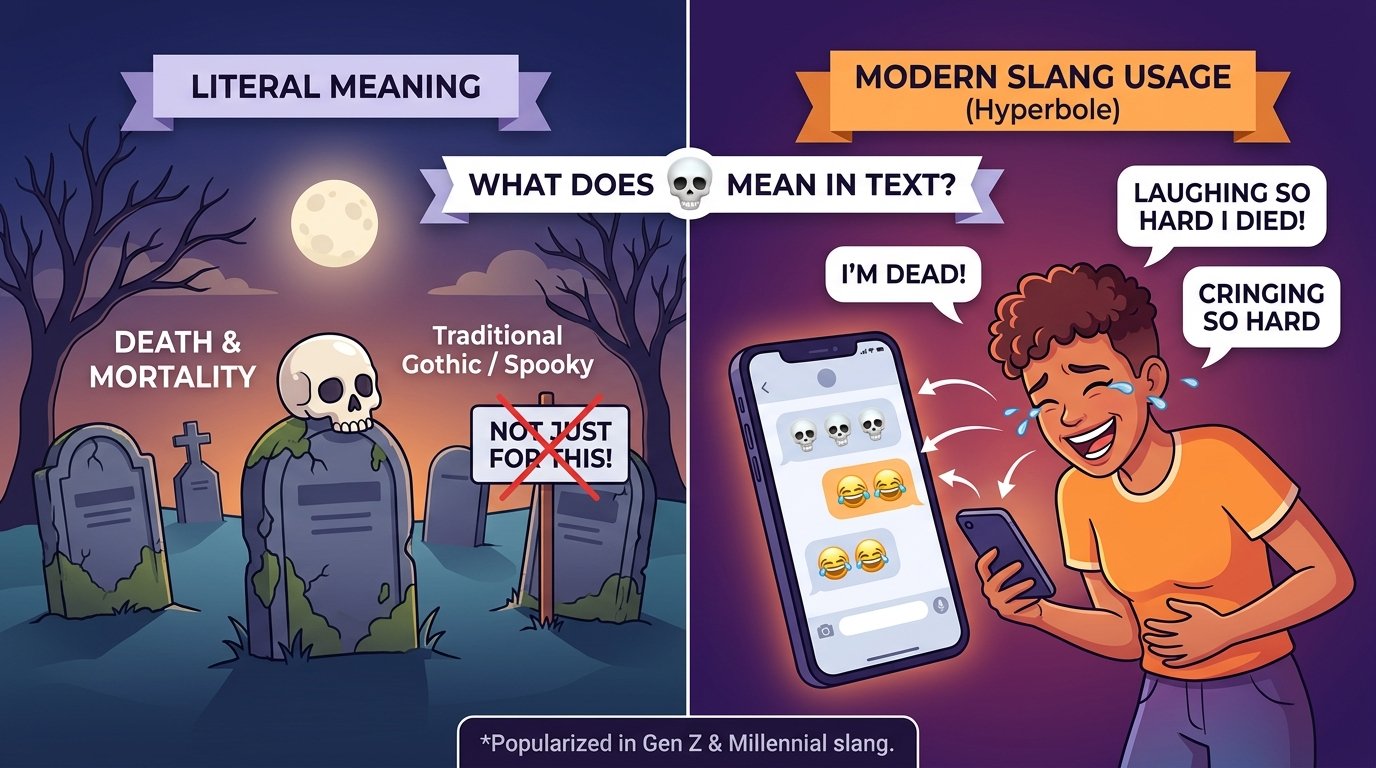
In modern texting, 💀 almost always means “I’m dead” as in, laughing so hard, so embarrassed, or so shocked that you’ve metaphorically ceased to function. It has almost nothing to do with actual death.
It’s the 2026 version of “lol” or “haha,” just more dramatic and more Gen Z. You’ll see it flooding TikTok comment sections, group chats, and Instagram DMs constantly. Nine times out of ten, if someone sends you a skull, they’re reacting to something funny, cringe-worthy, or unbelievable.
The Original Meaning of the Skull Symbol (Before Emojis Were a Thing)
For most of human history, the skull meant one thing: death.
Pirates flew it on their flags to terrorize merchant ships. Medieval artists painted it into religious scenes as a reminder that life is short a concept they called memento mori, Latin for “remember you will die.” Poison bottles were stamped with it as a warning. Alchemists used it in their manuscripts. It showed up on gravestones, in horror art, and eventually on Halloween decorations worldwide.
When emoji keyboards first introduced 💀 in Unicode, the assumption was the same danger, death, the macabre. Parents who grew up seeing that symbol on cleaning products under the sink weren’t wrong to associate it with something serious.
So how exactly did a death symbol become the funniest emoji on the internet? That’s where things get interesting.
See Also: https://garminlive.com/ffs-meaning-in-text-what-it-really-means-and-how-people-use-it/
How the Skull Emoji Meaning Changed From Death to “I’m Literally Dying”
Here’s the thing about language: it doesn’t sit still. And online slang moves faster than almost anything else.
In the early 2010s, 💀 was mostly used for edgy humor, Halloween captions, or anything with a dark aesthetic. It wasn’t common in everyday texting people still had 😂 and “lmao” for that. But slowly, something shifted.
By the late 2010s, the phrase “I’m dead” had become completely standard slang for “that was hilarious.” People were typing it all the time and naturally, the skull emoji became its visual shorthand. It felt more visceral than a laughing face. More expressive. The morbidity of it was part of the joke.
Then 😂 ran into a problem. Parents started using it. Corporations put it in their social media posts. Once it became associated with “adults trying to seem fun,” it lost its appeal for younger users almost overnight. A 2021 article in The Mirror noted that Gen Z had largely declared 😂 uncool and the skull emoji stepped in to fill the gap.
By 2022 and 2023, 💀 was the primary laughter emoji for Gen Z and younger millennials. A published study on ResearchGate, “The Skull Emoji in Gen Z Internet Slang: A Study of Its Use as Tone Tag and Punctuation” (2024), confirmed what anyone scrolling TikTok already knew the skull wasn’t just being used as a reaction anymore. It was functioning as punctuation, a tone marker that signals a message is meant to be read as comedic or ironic.
That’s a remarkable transformation for a symbol that once meant “danger: do not drink.”
All the Different Ways People Use the Skull Emoji 💀 in 2026
The skull isn’t a one-trick pony. Depending on the context, it can mean several different things though they’re all in the same general emotional family.
1. “I’m Dead” from Laughing (Most Common Use)
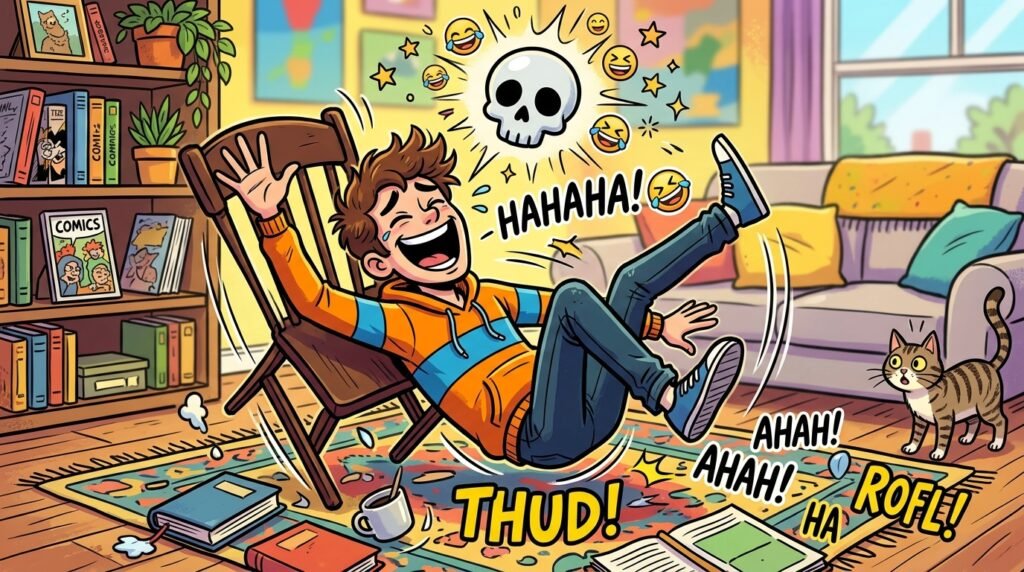
This is the big one. Someone posts something hilarious, says something unexpected, or tells a story that’s too good and the reply is 💀.
It’s pure comedic reaction. Saying “I’m deceased” or “you killed me” has been slang for “I’m laughing really hard” for years. The skull just makes it faster to type.
Real examples you’d actually see:
- “He texted his boss ‘good night babe’ by accident 💀”
- “She asked her professor what an essay was 💀💀💀”
- “I just sneezed in complete silence in the library 💀”
One important thing to know: the number of skulls matters. A single 💀 means “ha, that’s funny.” Three or more means you’re genuinely losing it. We’ll break that down more in its own section.
2. Extreme Embarrassment or Secondhand Cringe
This one’s slightly different from pure laughter. It’s that specific feeling where something is so awkward you want the earth to open up and swallow you or the person you’re watching.
It’s not “I’m laughing so hard.” It’s more like “I cannot continue existing after witnessing that.”
- “I waved back at someone who was waving at the person behind me 💀”
- “My mom commented on my Instagram post with ‘looking good kiddo!!!’ in front of everyone 💀”
- “I said ‘you too’ when the waiter told me to enjoy my meal 💀”
If you’ve ever texted a friend “please kill me” after doing something embarrassing, that’s exactly the energy. The skull captures it in one character.
3. Shock, Disbelief, or Speechlessness
Sometimes you read something and there’s literally nothing to say. No words. Just 💀.
This usually happens when something is so outrageous, so unexpected, or so beyond comprehension that a laughing emoji doesn’t feel right it’s not even funny, it’s just unbelievable.
- “He showed up to the interview 45 minutes late and asked for a raise 💀”
- “She genuinely didn’t know tomatoes were a fruit 💀💀”
Often in these cases, the skull stands completely alone as the entire reply. No added text. The skull IS the response.
4. Dark Humor and Sarcasm About Stress
College students, young professionals, and anyone drowning in responsibilities use this one constantly.
- “Three assignments due tomorrow, I haven’t started any of them 💀”
- “Finals week 💀💀💀💀”
- “Just saw my bank account 💀”
It’s performative suffering making a joke out of being overwhelmed. Nobody is actually in crisis. It’s a way of saying “this situation is objectively terrible and I am choosing to laugh at it.”
From what I’ve seen, this usage spikes around exam seasons and end-of-quarter work crunches. It’s dark humor as a coping mechanism, which is a pretty human thing to do.
5. Actual Death, Danger, or Serious Context (Rare but Real)
Worth mentioning because it does still happen. Halloween captions, true crime discussions, horror content, and warning labels online occasionally use 💀 in its more literal sense.
“Stay away from this trail after dark 💀” reads differently than “This burrito is going to kill me 💀.”
Quick tip: If the surrounding message is clearly serious and the topic involves actual danger or loss, the skull may not be a joke. Context from the whole conversation matters more than the emoji alone.
💀 vs. ☠️ What’s the Difference? (The One Thing Most Articles Miss)
Almost nobody talks about this, and it genuinely trips people up.
💀 and ☠️ are two completely separate emojis with different names, different designs, and different vibes. Using them interchangeably is a mistake.
Here’s the breakdown:
| 💀 Skull | ☠️ Skull & Crossbones | |
|---|---|---|
| Typical use | Humor, laughter, reaction | Danger, warning, edgy aesthetic |
| Generation | Gen Z dominant | All ages |
| Tone | Playful, dramatic | Dark, serious, stylized |
| Where you’ll see it | TikTok, Instagram, Snapchat, texting | Gaming, Discord, tattoo culture, warnings |
The 💀 skull faces forward, looks almost cartoonish on most platforms, and has been fully adopted as a comedy emoji. It’s cheerful in its morbidness, if that makes sense.
☠️ has the crossed bones beneath it and carries a distinctly darker, more intentional energy. It’s what you’d see on a gaming clan’s Discord server, a metal band’s merch, or an actual hazard label. It’s not usually deployed for laughs.
If someone texts you ☠️ out of nowhere, it does carry a slightly different weight than 💀. Not necessarily alarming, but more deliberate and stylized.
See Also: https://garminlive.com/what-wdym-stands-for-how-to-use-real-examples-2026-guide/
What Does the Skull Emoji Mean on Each Platform?
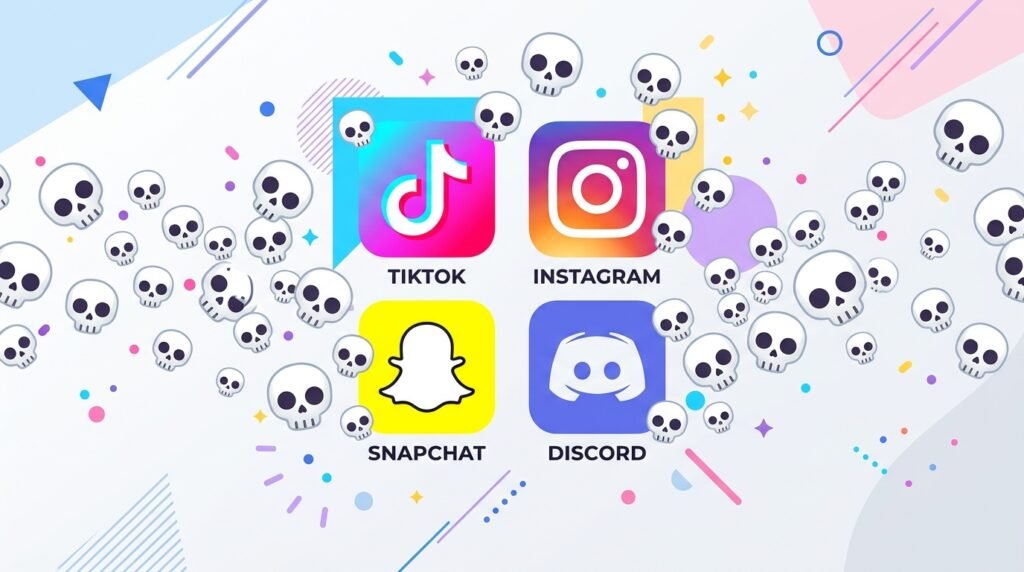
The core meaning stays consistent, but the culture around it shifts depending on where you are.
Skull Emoji on TikTok 💀
TikTok is basically ground zero for this emoji. The comment sections are filled with 💀 on anything remotely funny, embarrassing, or chaotic. It’s also used in video captions creators will often write something like “POV: you called your professor ‘dad’ 💀” and the skull is part of the comedic delivery.
On TikTok, getting a lot of 💀 comments is actually a compliment. It means people found your content genuinely funny.
Skull Emoji on Instagram
Same energy as TikTok it lives in comments and DMs. Instagram Reels especially bring out the skull reactions. Someone fails a trick, slips on ice, says something unintentionally hilarious 💀💀💀 floods the comment section.
You’ll also see it in captions where someone is self-deprecating about their own life choices.
Skull Emoji on Snapchat
Here’s something almost nobody explains properly: on Snapchat, 💀 has a platform-specific meaning that has nothing to do with laughing.
When you see 💀 appear as a Friend Emoji next to someone’s name, it means you used to be each other’s #1 Best Friend (you snapped each other the most), but that streak has ended. It’s basically Snapchat’s way of saying the friendship is “dead” at least in terms of your snap activity.
So if you see 💀 next to your ex’s name on Snapchat, that’s Snapchat’s algorithm telling you something, not that person sending you a message.
In actual Snapchat messages, though, 💀 works the same way as everywhere else humor and reaction.
Skull Emoji in Gaming and Discord
In gaming, 💀 carries double duty. It’s used in its literal sense too death screens, kill confirmations, respawn taunts. “You died. 💀” is a perfectly functional use.
But it’s also used for comedic reactions to bad plays, clutch fails, and general chaos in voice chats. “Bro just walked into four enemies with a pistol 💀💀💀” that’s pure gaming humor.
Discord servers tend to use both 💀 and ☠️ freely, and the community norms of each specific server usually determine which is funnier in context.
The Skull Emoji and Gen Z Why It Replaced “LOL” and 😂
This is worth understanding properly, not just as a fun fact but as a window into how online language actually evolves.
Every generation’s laugh-text has a lifecycle. “Haha” feels sincere but almost old-fashioned. “LOL” was everywhere in the 2000s, then became so automatic it stopped meaning anything. People would type “lol” while staring blankly at their phone, not even smiling.
😂 took over around 2012–2015 and dominated for years. But the same thing happened overuse, then corporate adoption. When brands started putting 😂 in their tweets, when every parent was reacting to family photos with it, it lost its authenticity for younger users. The crying-laughing emoji became the emoji equivalent of cargo shorts functional but deeply uncool.
Enter 💀. It’s more hyperbolic. The jump from “I’m laughing” to “I am literally dead from laughing” is funnier, more dramatic, and more expressive. It suits the Gen Z communication style, which leans heavily on exaggeration for comedic effect.
The ResearchGate study mentioned earlier found something really interesting: Gen Z isn’t just using 💀 as a reaction. They’re using it as a tone tag a signal that tells the reader “this entire message is meant to be funny, don’t take it seriously.” It functions almost like a genre marker, not just an emotion indicator.
That’s genuinely sophisticated use of a visual symbol. Language nerds should find that fascinating.
How Many Skull Emojis? The Number Changes Everything
This is one of the most practical things to understand about 💀, and most guides gloss over it.
The quantity isn’t random. It’s a pretty reliable intensity meter:
| Number | What It Actually Signals |
|---|---|
| 💀 (one) | Mildly funny, slight cringe, polite reaction |
| 💀💀 | Genuinely amusing, worth a real laugh |
| 💀💀💀 | Laughing hard, high cringe, you’ve done something great |
| 💀💀💀💀💀+ | Complete system failure, they cannot function |
Think of it like a laugh-o-meter. One skull is the equivalent of a quiet “ha.” Five skulls means your friend is rolling on the floor and will probably screenshot this to send to someone else.
If someone replies to your message with a wall of skulls and nothing else, you’ve achieved something genuinely funny. Take the win.
A Parent’s Guide to the Skull Emoji Don’t Panic
If you’re a parent who found this page after seeing 💀 all over your kid’s phone, first: good on you for looking it up instead of assuming the worst.
Here’s the short version your kid is fine. They’re not obsessed with death, they’re not being dark or worrying, and that emoji doesn’t mean what you think it means.
When teenagers and young people send 💀, they almost always mean one of two things: something was really funny, or something was so embarrassing they’re pretending to die from cringe. Both are completely normal.
A text exchange that looks alarming to a parent:
Friend: “I just walked into a glass door in front of my entire class” Your kid: “💀💀💀💀”
Translation: your kid found that hilarious. That’s it.
The one thing worth knowing: if the surrounding conversation is genuinely heavy if your child is talking about something stressful and using lots of dark language beyond the emoji that’s worth a conversation. But the skull emoji alone is not a red flag. It’s been the standard humor emoji for this age group for years now.
If you want to actually connect with your teenager about what they’re texting, asking “what were you guys laughing about?” is always a better move than quietly worrying about a cartoon skull.
How to Reply When Someone Sends You the Skull Emoji 💀
Nobody ever writes about this, which is strange because it comes up all the time.
You get a 💀. Now what?
It depends entirely on the situation:
If they’re laughing at something funny: Match the energy. Send 💀 back, add something funny in return, or just acknowledge the moment. “I know 💀 I was there” works perfectly.
If they’re cringing about themselves: A little validation goes a long way. “💀💀 I would’ve done the exact same thing” or “the glass door ALWAYS wins” keeps it light and makes them feel better.
If they’re reacting to something shocking: You can pile on “💀 RIGHT?? I literally couldn’t speak” or add context if you know more about the situation.
If you genuinely can’t tell what they mean: It’s completely okay to just ask. “Is that a good skull or a bad skull 💀” is a perfectly normal text to send and it’ll usually get a laugh out of them anyway.
The real mistake is overanalyzing it. Most of the time, 💀 is just someone’s way of saying “I felt something strongly and this emoji summed it up faster than typing would.”
See Also: https://garminlive.com/tmb-meaning-explained-definitions-uses-slang-real-examples/
When NOT to Use the Skull Emoji (Avoid These Mistakes)
There’s a right context and a very wrong context for 💀, and people do get this wrong.
Don’t use it in condolence messages. If a friend tells you their pet died, or someone in their family is sick, sending 💀 even out of pure habit is going to land horribly. It reads as insensitive at best.
Don’t use it in professional communication. Not in emails to clients. Not in messages to your boss unless you have an extremely specific kind of relationship. Not in job applications. Casual Slack messages with a close colleague in a laid-back company? Maybe. Anything external or formal? No.
Don’t use it when discussing actual deaths or tragedies. If someone mentions a news story about a disaster, a 💀 reply doesn’t work as dark humor in that context. It just looks callous.
Don’t force it if you’re not in that generation. This is less about rules and more about authenticity. If you’re significantly older and you’re trying to seem relatable by using 💀 in conversations with young people they’ll notice, and it’ll have the opposite effect. You don’t need to adopt every piece of current slang to connect with someone.
Simple rule: If you’d describe the topic as “serious,” skip the skull.
How the Skull Emoji Looks Different on Every Device
A quick one, but worth knowing because it does affect the overall feel of the message.
The 💀 emoji has the same Unicode code point everywhere, but every platform renders it slightly differently:
Apple (iPhone/Mac): Cartoonish, slightly rounded, almost cute. It’s almost friendly-looking, which actually adds to the comedic effect.
Google (Android, Gmail): Flatter, cleaner, slightly more graphic. A bit more neutral in expression.
Samsung: More stylized, with slightly more detailed shading. Lands somewhere between Apple’s cute version and Google’s flat one.
Twitter/X and WhatsApp: Both use their own custom designs WhatsApp’s is simpler, Twitter’s has a bit more character.
The meaning doesn’t shift based on the design. But if you’re on iPhone and you send 💀 to someone on Android, just know that they’re seeing a slightly different visual. Usually not an issue context handles the rest.
Real-Life Examples of the Skull Emoji in Text Conversations
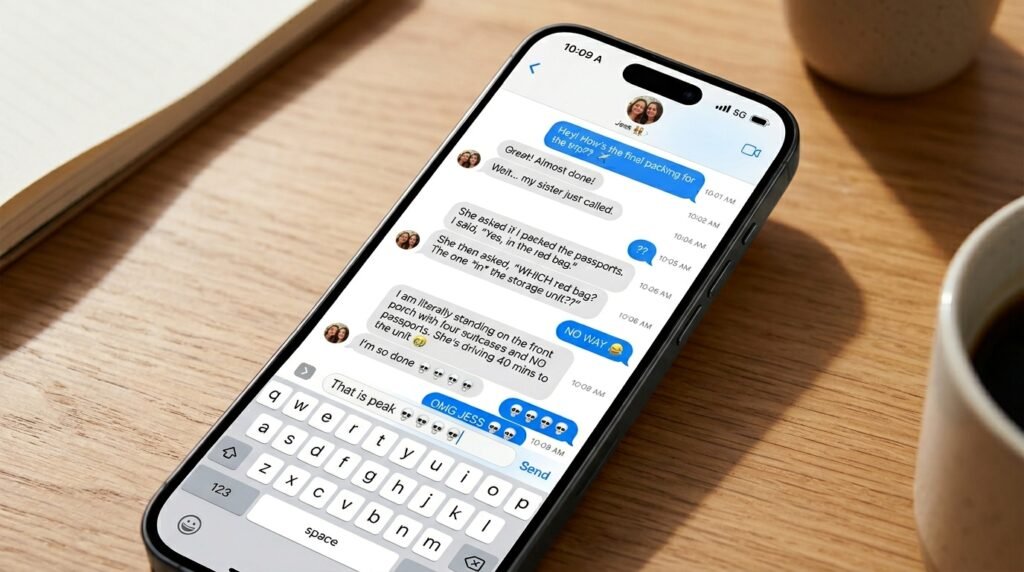
Let’s just run through some realistic scenarios, because nothing explains emoji usage better than seeing it in context.
Friend group chat:
“Just found out our professor canceled the exam AND dropped our lowest grade 💀” “💀💀 he really said treat yourself”
Self-deprecating text:
“I’ve been wearing my shirt inside out all day and nobody told me 💀”
Reacting to someone else’s story:
“He asked her out over a school-wide announcement 💀💀💀” “There is no way” “I watched it happen 💀”
Late-night chaos:
“Just knocked over an entire glass of water on my laptop 💀” “NOOO” “It’s fine it’s fine 💀 everything is fine”
TikTok comment section style:
Video of a dog dramatically falling off a couch Comments: “💀💀💀💀” “THE WAY HE LOOKED AT THE CAMERA 💀” “I’m not okay 💀”
Secondhand cringe:
“My dad just tried to do the ‘rizz’ thing in front of my friends” “💀💀💀💀 I’m so sorry” “I need to move countries 💀”
Stress humor:
“It’s 2am and I haven’t started this essay that’s due at 8 💀” “I’ll light a candle for you 💀”
These are the kinds of exchanges 💀 actually lives in. Nothing dramatic, nothing worrying just people communicating with a symbol that does the job faster than words.
Skull Emoji in Pop Culture Memes, Viral Moments, and Trends
The phrase “I’m dead” or “I died” as slang for laughter has been around since at least the mid-2000s on internet forums. The skull emoji didn’t create that expression it just gave it a visual form that was faster to type.
What’s interesting is watching how the emoji crossed into mainstream culture. Brands started picking it up around 2019–2021, which is always the sign that something has peaked in authenticity for younger audiences. A fast food chain tweeting “💀💀💀 we can’t” in response to a meme is technically using the emoji correctly, but it feels hollow because everyone knows the social media manager is doing a bit.
In gaming culture specifically, 💀 has a second life. Games like Minecraft, Among Us, and countless others have made the death-symbol aspect of 💀 into its own comedic language. “You died 💀” under a clip of someone making a spectacularly bad decision has been a staple of gaming content for years.
Fan communities fanfiction writers, K-pop stans, anime fans adopted 💀 as what researchers call a tone tag: a marker you drop at the end of a post to signal “this is a joke” or “I am being dramatic for effect.” It keeps the tone clear in spaces where misreadings can cause real friction.
That’s a pretty evolved use for an emoji that started life on a poison label.
Frequently Asked Questions About the Skull Emoji 💀
What does 💀 mean in a text from a guy?
It almost always means he found something funny or is reacting with exaggerated drama. The skull emoji carries the same meaning regardless of who’s sending it what matters is the context of the conversation, not the sender’s gender.
What does 💀 mean from a girl in texting?
Exactly the same thing humor, cringe, or mock-death from embarrassment. There’s no gender-specific meaning to 💀. If a girl sends you 💀, she thought something was funny, awkward, or unbelievable.
Does the skull emoji mean I love you?
No, not by itself. The skull emoji doesn’t carry romantic meaning. In certain playful contexts (“you’re killing me 💀”), it can signal strong affection in a jokey way but you shouldn’t read romance into 💀 on its own. If you’re trying to decode someone’s feelings, look at the whole conversation, not just the emoji.
Is the skull emoji bad or offensive?
Generally no. It’s one of the most casually used emojis in current texting culture. It becomes offensive if you drop it in a genuinely serious conversation or after someone shares painful news in that case, it reads as dismissive. Outside of those contexts, it’s lighthearted.
What’s the difference between 💀 and 😂?
Both signal laughter, but 💀 reads as more intense and more current. Many younger users see 😂 as dated now it became so associated with a certain type of “trying to be fun” communication that it lost its edge. 💀 says you’re so amused you’ve metaphorically died. That extra layer of drama is the whole point.
Why do teens use skull emoji so much?
It’s the current go-to for expressing laughter and cringe online. The lifecycle goes: “haha” → “lol” → “lmao” → 😂 → 💀. Each version replaced the last as it got overused. The skull’s morbid humor fits the Gen Z style of exaggerated, ironic self-expression. It probably won’t last forever either something will eventually replace it.
What does 💀💀💀 (multiple skull emojis) mean?
Increasing intensity. One skull is a mild reaction. Three is genuinely funny. Five or more means the person is completely losing it and possibly screenshotting the conversation to share elsewhere. More skulls = stronger reaction.
Can I use the skull emoji at work?
Depends heavily on the workplace. Casual, creative-industry Slack channels with close colleagues? Probably fine. Formal emails, client communication, or anything external? Skip it. When in doubt, err on the side of professionalism the risk isn’t worth it.
What does the skull emoji mean on Snapchat specifically?
Two different things depending on context. In a regular Snapchat message, 💀 means the same as anywhere else humor and reaction. But if you see 💀 appearing as a Friend Emoji icon next to someone’s name in your contacts list, Snapchat is telling you that you two were each other’s #1 Best Friend (you snapped each other the most) but that’s no longer the case. It’s the app saying the friendship, at least by snap frequency, has ended.
Is the skull emoji related to death or depression?
Not in the way it’s typically used. The overwhelming majority of 💀 usage is about humor, laughter, and dramatic reactions. If you’re genuinely worried about someone based on a text conversation, the skull emoji alone isn’t what you should be looking at it’s the tone and content of everything around it. One skull after a funny story is just a reaction. Repeated, unprompted skull emojis in the middle of a distressing conversation would be worth more attention.
About The Author