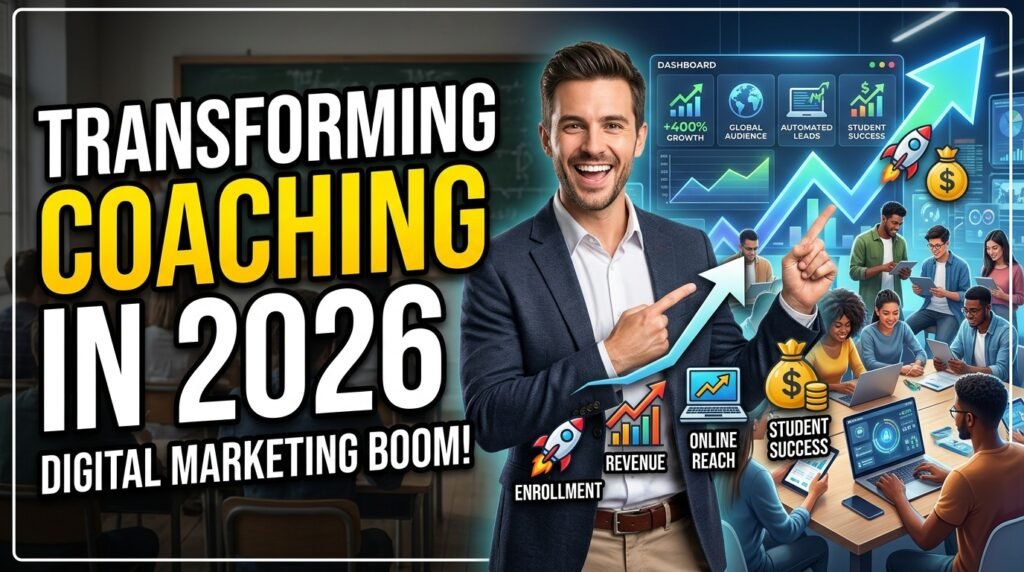

How digital marketing is transforming coaching institutes in 2026 is impossible to ignore now. A few years ago, most coaching institutes relied on roadside banners, newspaper ads, and pamphlets stuffed into newspapers. Today, even small academies are using AI-powered campaigns, Google rankings, and Instagram reels to attract students online.
That shift happened fast.
Students in 2026 behave differently. Before joining a coaching center, they check reviews, search on Google, compare fees online, watch demo videos, and sometimes even judge an institute by how active it is on social media. Parents do the same. If an institute barely exists online, many people assume it’s outdated.
From what I’ve seen, coaching centers that adapted early are growing faster than institutes with bigger buildings but weak digital presence.
Why Coaching Institutes Need Digital Marketing in 2026
Shift From Traditional Marketing to Digital Growth
Traditional marketing still works to some extent, especially for local awareness. But the difference now is measurable reach.
A newspaper ad disappears in a day. A well-optimized Instagram reel can bring inquiries for months.
Students no longer wait for flyers. They search things like “Best IELTS Coaching in Faisalabad” or “MDCAT preparation near me.” If your institute doesn’t appear there, another one gets the lead.
Here’s a simple comparison:
| Traditional Marketing | Digital Marketing |
|---|---|
| Newspaper ads | Google Search visibility |
| Flyers & banners | Instagram reels |
| Random outreach | Targeted student ads |
| Hard to track results | Real-time analytics |
| Expensive repetition | Long-term online visibility |
Many institute owners overlook this part: digital marketing is not only about ads. It’s also branding, trust, reputation, and consistent communication.
Read More: https://garminlive.com/7-mistakes-that-waste-time-budget-when-hiring-freelance-ai-engineers/
Top Digital Marketing Trends Transforming Coaching Institutes
AI-Powered Marketing & Automation
AI tools are quietly changing how coaching institutes handle admissions.
A coaching institute using WhatsApp automation can respond instantly to leads, even at midnight. Chatbots answer FAQs, CRMs track inquiries, and automated email sequences follow up with students who downloaded a prospectus.
That saves time, but more importantly, it reduces missed leads.
I recently noticed a local academy sending automated reminders for free demo classes through WhatsApp. Their response rate was surprisingly high because students prefer quick mobile communication over phone calls now.
Voice Search & Mobile-First SEO
Students search differently today. Instead of typing short keywords, many use voice search like:
“Which academy near me offers SAT preparation?”
That’s why mobile SEO matters more than desktop optimization now. If an institute’s website loads slowly on phones, people leave within seconds.
Google also prioritizes mobile-friendly websites in rankings, which directly impacts student inquiries.
Hyper-Local Student Targeting
Hyper-local advertising is becoming incredibly effective for coaching centers.
Instead of targeting an entire city, institutes now run ads for specific neighborhoods, colleges, or even nearby schools. Geo-targeted campaigns lower advertising costs and improve conversion rates.
For local institutes, this strategy works better than broad national campaigns.
SEO Strategies Helping Coaching Institutes Rank on Google
Local SEO for Coaching Institutes
Local SEO has become one of the strongest student acquisition channels.
When someone searches “Best IELTS Coaching in Faisalabad,” Google usually shows map listings first. Institutes with optimized Google Business Profiles, positive reviews, updated photos, and local keywords dominate those results.
Many coaching centers ignore review collection, which is a mistake. Students trust reviews more than promotional claims.
Content Marketing & Blogging
Blogging still works in 2026, especially for educational businesses.
Students constantly search for guidance:
- “How to prepare for MDCAT in 3 months”
- “Best IELTS writing tips”
- “How to improve SAT score”
Institutes publishing useful content build authority naturally. The traffic compounds over time.
From what I’ve observed, educational blogs perform best when they solve specific student problems instead of aggressively promoting admissions.
Technical SEO Essentials
A good-looking website alone is not enough.
Institutes need:
- Fast page speed
- Mobile optimization
- Clear navigation
- Proper internal linking
- SEO-friendly landing pages
A slow website can quietly kill admissions because students rarely wait for broken pages to load.
Social Media Marketing for Coaching Institutes
Instagram & TikTok Reels for Student Engagement
Short-form video content is dominating educational marketing.
Before-and-after student success reels, quick study tips, classroom moments, and result announcements generate strong engagement. Students relate more to authentic content than polished advertisements.
Some institutes are even using educational memes to improve reach. Surprisingly, it works.
Facebook Ads for Admissions
Facebook still performs well for local admissions campaigns because parents actively use it.
The most effective ads usually include:
- Free demo class offers
- Scholarship tests
- Admission deadlines
- Student success stories
Clear CTAs like “Book Free Demo Class” or “Apply for Scholarship Test” convert much better than generic branding ads.
LinkedIn Branding for Professional Courses
LinkedIn has become useful for institutes offering professional certifications, language courses, and career-focused training.
An institute posting faculty insights, student placements, and industry partnerships appears more credible to working professionals.
Paid Advertising Strategies That Increase Student Enrollments
Google Ads for Coaching Institutes
Google Ads work well because they capture existing demand.
If someone searches “SAT coaching near me,” they already have intent. A properly optimized ad can bring highly targeted leads.
But many institutes waste money by sending traffic to weak landing pages with confusing forms and poor mobile experience.
Meta Ads & Retargeting
Retargeting is underrated.
A lot of students visit admission pages without filling forms. Meta retargeting ads remind them later through Instagram or Facebook.
This simple strategy often increases conversion rates without increasing ad budgets too much.
YouTube Advertising for Educational Brands
Video ads create trust faster than text ads.
Students want to see classrooms, faculty, teaching style, and real success stories before enrolling. Institutes using short YouTube video campaigns are building stronger credibility than those relying only on static graphics.
Content Marketing That Builds Trust & Authority
Blogging for Student Queries
Educational blogs should answer genuine student concerns, not act like sales pages.
Useful topics include:
- Exam preparation strategies
- Time management tips
- Subject-specific guidance
- Career advice
Helpful content builds long-term trust.
Video Marketing & Webinars
Free webinars still generate quality leads organically.
When students attend a useful webinar, they already experience the teaching style before enrollment. That reduces hesitation.
I’ve seen institutes fill entire batches through free online workshops alone.
Email Marketing for Student Retention
Most institutes focus only on admissions but ignore retention.
Simple email campaigns sharing test schedules, study material, and performance updates keep students engaged and reduce drop-offs.
Website Optimization for Higher Admissions
Fast & Mobile-Friendly Websites
Students browse mostly on phones now.
A cluttered desktop-style website frustrates users quickly. Clean mobile layouts, fast loading speed, and simple inquiry forms matter more than flashy animations.
Landing Pages That Convert
Good landing pages are focused.
Instead of sending visitors to a generic homepage, institutes should create dedicated pages for each course with clear benefits, testimonials, and admission CTAs.
Student Testimonials & Trust Signals
Reviews, screenshots of results, faculty credentials, and student success stories strongly influence decisions.
People trust proof more than promises.
See Also: https://garminlive.com/what-is-artificial-intelligence/
Common Digital Marketing Mistakes Coaching Institutes Should Avoid
Ignoring Analytics & Data
Many institutes run ads blindly without tracking conversions.
Analytics reveal which campaigns bring actual admissions instead of just clicks. Without data, scaling becomes guesswork.
Inconsistent Branding
Posting random content with different colors, logos, and messaging weakens trust.
Strong educational brands maintain consistency everywhere website, social media, ads, and videos.
Over-Promotional Content
Students quickly ignore pages that constantly scream “Admissions Open.”
Educational content should provide value first. Constant promotion reduces engagement over time.
Future of Digital Marketing for Coaching Institutes Beyond 2026
Personalized Student Experiences
AI-driven personalization will become standard.
Students will receive customized emails, course suggestions, and study recommendations based on behavior and interests.
AR/VR & Interactive Learning Promotion
Interactive demos, virtual classrooms, and immersive learning experiences will become marketing tools themselves.
Institutes adopting these technologies early may stand out significantly.
Data-Driven Enrollment Strategies
Future coaching marketing will rely heavily on predictive analytics.
Institutes will track student behavior patterns to improve conversions, reduce drop-offs, and optimize marketing budgets more accurately.
The gap between digitally advanced institutes and traditional coaching centers is already visible. By 2026 and beyond, that gap will probably become much wider.
About The Author




Pingback: The Power of Email Marketing: How to Grow Your Business Faster