
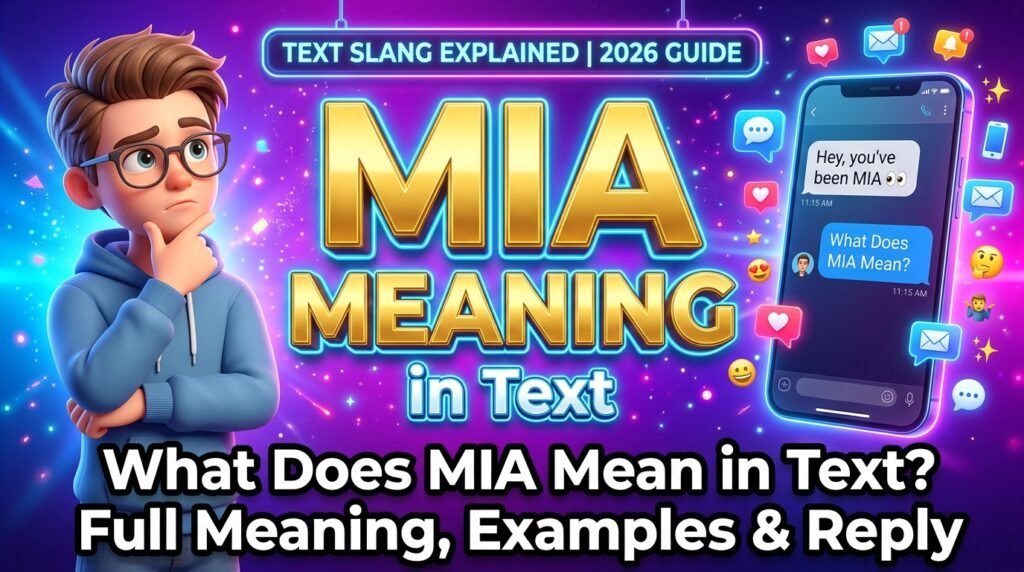

What exactly does MIA Means in text. MIA is an acronym for ‘Missing In Action.’ If you received a message using this term and wondered what it meant, rest assured that you are not alone. MIA is an informal expression commonly used in texting, social media, and online communication to refer to a person who is either not in contact lately or is not around and has ‘disappeared.’ Knowing the meaning of MIA will help you read messages in a better way and make you more knowledgeable about modern digital communication. In this article, you will find out the meaning of MIA in texting, how this term is used, and situations when it is commonly applied.
Quick Snippet Answer
MIA in a text means “Missing In Action.” It’s used when someone hasn’t replied, posted, or shown up for a while usually without explanation. It can be playful (“you’ve been MIA!”) or slightly concerned, depending on the tone and relationship.
That’s the short version. Now let’s get into how people actually use it, because context changes everything here.
MIA Meaning in Text: The Simple Definition
What MIA Stands For
MIA is short for “Missing In Action.” That’s it no hidden meaning, no complicated backstory. Three letters, one idea: someone (or something) went quiet.
How MIA Is Actually Used in Everyday Texting
In real texting, MIA rarely carries its original heavy meaning. It’s mostly just a casual way of saying “where have you been?”
Here’s a quick breakdown of how it usually shows up:
| Term | Full Form | Common Tone | Typical Use |
|---|---|---|---|
| MIA | Missing In Action | Playful, sometimes concerned | Someone’s been unresponsive or absent |
A few real examples I’ve seen (and sent):
“lol where have you been, you’ve been MIA 💀”
“bro went full mia after payday lmaooo”
“you good? you’ve been kinda mia this week”
Notice the tone shifts a lot just based on punctuation and emoji. That’s actually the whole trick to reading this word correctly, and I’ll get into that more below.
Where Does MIA Come From? (Military Origin Explained)
The Original Military Meaning
MIA has real roots it’s a military classification used for soldiers who are missing after a battle or operation, with no confirmation of death or capture. It’s a serious term, and it’s still used that way in official contexts today.
How MIA Moved from the Battlefield to Group Chats
Language does this weird thing where serious terms get borrowed and softened over time. AWOL did it. MIA did it too.
Somewhere along the way, probably through military slang bleeding into pop culture and gaming communities, MIA started getting used for anyone who just… disappeared for a bit. Not in danger just off the grid.
I don’t think most people using it in a group chat are even thinking about the military meaning at all. It’s just become its own thing.
Don’t miss: https://garminlive.com/what-does-gdp-mean-in-text/
Is “MIA” a Name or an Acronym? (Content Gap Most Competitors Miss)
This is where a lot of people actually get tripped up, and weirdly, most articles online barely touch on it.
“Mia” is also one of the most popular baby names out there. So when you see a text like “Mia is MIA lol,” your brain has to do a double-take.
Here’s a quick way to tell the difference:
- MIA (all caps) usually signals the acronym missing, absent, ghosting a chat.
- Mia (name case) usually signals the person’s actual name.
The problem? Autocorrect and lazy typing ruin this rule constantly. Someone might text “mia hasn’t answered in days” and you genuinely can’t tell if they mean their friend Mia or the concept of being MIA.
From what I’ve seen, context is really the only reliable clue. If the sentence works better with a person’s name in that spot, it’s probably the name. If it reads more like a description of behavior, it’s the slang.
How to Use “MIA” in Different Texting Situations
Context changes the meaning of MIA more than people realize. Here’s how it plays out across different types of chats.
MIA With Friends (Casual Check-In)
This is the most common, most harmless use. It’s basically a lighthearted “hey, haven’t heard from you.”
“you’ve been so mia, did you fall off the face of the earth”
MIA in a Group Chat
Group chats love this word. If someone hasn’t posted in a while, expect someone to call it out.
“where’s [name], they’ve been mia for like a week”
MIA in Dating & Relationships
This one’s trickier. It can range from a light tease to a genuine “are we okay?” moment.
“you went mia after our date lol what happened”
If you’ve been dating someone and they suddenly use this word, pay attention to the punctuation. A question mark and a soft tone usually mean they’re just curious, not upset.
MIA at Work or in Professional Messages
I’d honestly avoid this one in anything formal. It’s fine in a casual Slack message between coworkers you’re friendly with, but I wouldn’t use it in a client email or with your manager unless your workplace is very laid-back.
“hey, noticed you were mia from the meeting, everything alright?”
If you need a safer alternative for professional settings, something like “I noticed you were unavailable” works just as well without the slang.
MIA in Gaming (League of Legends, Valorant, etc.)
Gamers use MIA constantly, but it means something slightly different here it’s a callout that an enemy player has disappeared from view and could be anywhere on the map.
“mid mia, watch your back”
This use case is honestly older in gaming culture than the casual texting version, and it’s a lot more literal.
MIA on Social Media (Instagram, TikTok, Snapchat)
Same idea as texting, just applied to posting habits.
“you’ve been mia on the gram, everything good?”
MIA vs. Similar Texting Terms (Comparison Table)
People mix these up constantly, so here’s a side-by-side.
| Term | Meaning | How Long It Lasts | Intentional? | Tone |
|---|---|---|---|---|
| MIA | Temporarily absent or unresponsive | Short to medium | Usually not | Playful, sometimes concerned |
| Ghosting | Deliberately cutting off contact | Often permanent | Yes | Cold, dismissive |
| AWOL | Absent without leave (also military-rooted) | Varies | Sometimes | Neutral to serious |
| Left on read | Message seen but not replied to | Short | Depends | Passive-aggressive |
| AFK | Away from keyboard, temporary | Very short | Yes | Neutral |
| Radio silent | No communication at all | Short to long | Depends | Neutral to concerned |
The main thing that separates MIA from ghosting is intent. Ghosting is usually a choice. MIA is more like life got in the way.
Don’t miss:https://garminlive.com/tb-meaning-explained-medical-tech-social-slang-definitions/
Is Being Called MIA a Bad Thing? Reading the Tone Correctly
Honestly, most of the time, no. It’s not an insult. But tone matters a lot here.
- Playful: “lol you’re so mia 😭” this is just teasing.
- Concerned: “hey, you’ve been mia, everything ok?” genuine check-in.
- Passive-aggressive: “wow you’re finally not mia” this one stings a little, and you’ll know it when you see it.
My honest take? If someone’s genuinely annoyed with you, they’ll usually say more than just “you’re mia.” A single lighthearted message with an emoji almost never means trouble.
How to Respond When Someone Calls You MIA (Practical Reply Scripts)
This is the part people actually need help with, so here are some real options.
If a Friend Says You’ve Been MIA
“haha I know, work’s been insane, I’m back now though”
Keep it light. No need to over-explain unless you actually owe them an explanation.
If Your Partner or Date Says You Went MIA
“sorry about that, my week got away from me how have you been?”
This does two things: owns it briefly, then redirects the conversation forward instead of dwelling on the gap.
If a Coworker Flags You as MIA
“yeah sorry, got pulled into back-to-back calls catching up now”
Short, professional, no drama.
The common thread in all three? Don’t over-apologize. A quick acknowledgment plus a reason (even a vague one) usually resets the conversation just fine.
When Should You Actually Worry About Someone Being MIA?
Most of the time, MIA is harmless. But there’s a difference between “annoying but harmless” and something worth actually paying attention to.
Signs it might be more than casual absence:
- No contact for several days, which is unusual for that person
- It’s completely out of character for how they normally communicate
- Other people in their circle also haven’t heard from them
If that’s the situation, I’d reach out once more, maybe check with mutual friends or family, and only escalate to something more serious like contacting authorities for a wellness check if it genuinely feels warranted. Don’t spiral over one unanswered text, but also don’t ignore a real pattern.
Other Meanings of MIA You Should Know
A few unrelated meanings worth knowing, just so you’re not thrown off elsewhere:
- Miami International Airport uses the code MIA you’ll see this on flight bookings and luggage tags.
- M.I.A. is also the stage name of a well-known musician.
- In formal and legal contexts, “Missing In Action” retains its original, serious military meaning.
None of these overlap much with texting slang, but it’s good to know they exist so you’re not confused if you see MIA used somewhere unexpected.
Related Texting Slang to Know
If MIA is new to you, these are probably worth learning too:
- AFK Away From Keyboard
- AWOL Absent Without Leave
- GMTA Great Minds Think Alike
- LMK Let Me Know
- HMU Hit Me Up
- IRL In Real Life
- TBH To Be Honest
Frequently Asked Questions About MIA in Texting
What does MIA mean in a text from a girl or guy? Same meaning either way they’re saying you (or someone) have been unresponsive or absent for a while.
What does “going MIA” mean? Disappearing or becoming unreachable, often without warning.
Is MIA the same as ghosting? Not quite. MIA usually implies temporary or unexplained absence, while ghosting implies a deliberate, permanent cutoff.
What does MIA mean on Snapchat or Instagram? Someone hasn’t posted, replied to DMs, or been active for a while.
What does MIA mean in gaming? A player or enemy is missing from their expected location on the map.
Can MIA be used for objects, not just people? Yes you’ll hear things like “my charger is MIA” pretty often.
How do you pronounce MIA in this context? Said as three letters: M-I-A.
Is it okay to use MIA in a professional email? It’s fine for internal or casual messages, but I’d avoid it in anything formal or client-facing.
Quick Recap: What MIA Really Means
At the end of the day, MIA in a text just means someone’s been absent or unresponsive for a while nothing more sinister than that, most of the time.
Read the tone, look at the emoji, and consider who’s sending it. That combination will almost always tell you exactly what they mean.
Next time someone calls you MIA, you’ll know exactly how to read it and how to reply.
About The Author