
What Does DTM Mean in Text? The Real Answer
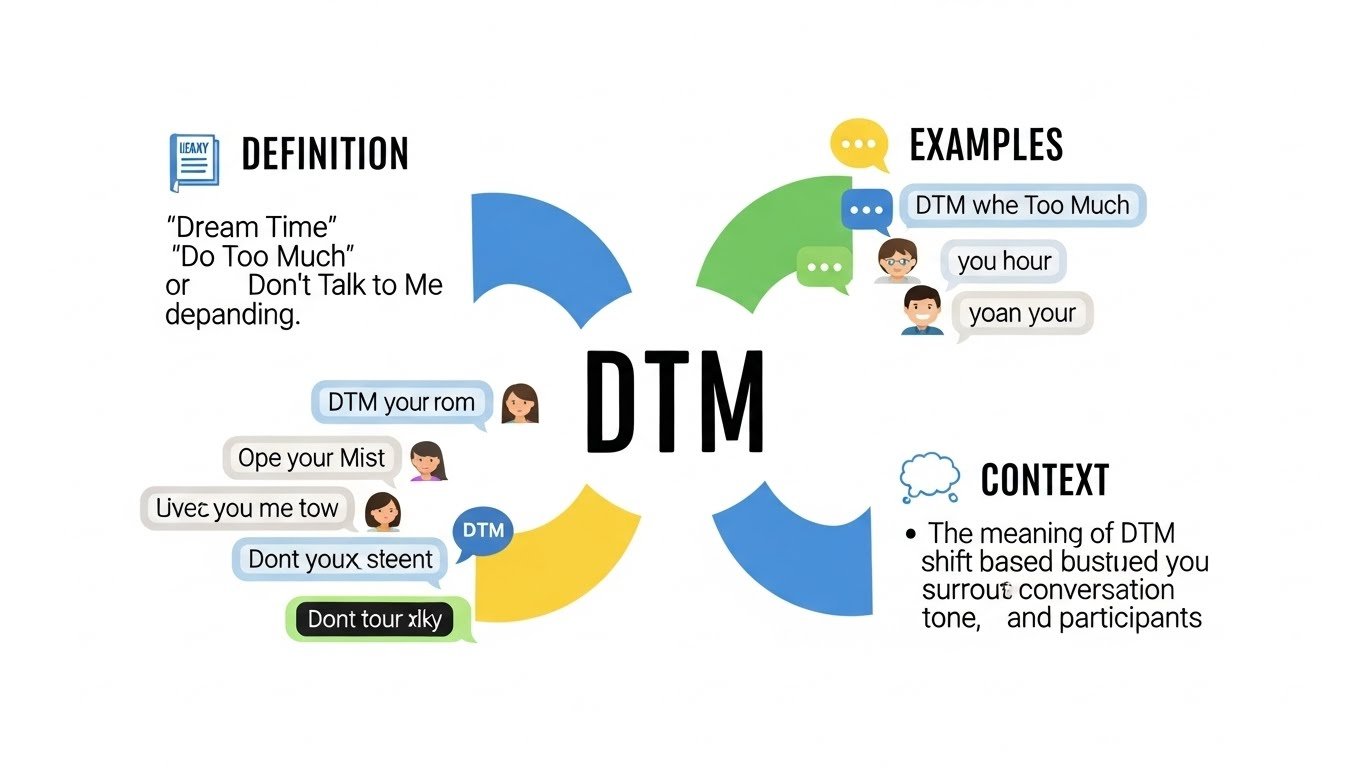
If someone just text you “DTM” with zero context, here’s the quick version: DTM most often means “Doing Too Much” used when someone’s being extra, dramatic, or putting in way more effort than a situation calls for. But it can also mean “Don’t Text Me,” “Dead To Me,” or “Down To Meet,” depending entirely on who sent it and what you were just talking about. There’s no single fixed meaning. Context does all the work here.
I’ve spent a fair amount of time in group chats, comment sections, and DMs where three letters like this show up with zero explanation, and DTM is one of the messier ones. Not because it’s complicated, but because four completely different phrases got flattened into the same acronym, and nobody agreed on which one wins.
Let’s actually sort this out.
The Main DTM Meanings in Text (Ranked by How Often You’ll Actually See Them)
1. “Doing Too Much” — the most common one
This is the one you’ll run into most, especially in comment sections, group chats, and reaction posts. It’s used to call out someone who’s overreacting, overexplaining, or putting in effort nobody asked for.
Example:
Friend: “I wrote her a 4-paragraph apology for showing up 10 minutes late.”
You: “bro that’s DTM, just say sorry 😭”
It’s not usually mean. It’s more of a “chill out” nudge, often said with affection rather than actual criticism. From what I’ve seen, this is almost always the intended meaning when DTM shows up in a public or semi-public context comments, group chats, meme captions. It gets murkier in one-on-one texts, which is where the other meanings start creeping in.
2. “Don’t Text Me” — the blunt shutdown
This one shows up almost exclusively in one-on-one conversations, usually after an argument or when someone’s clearly done engaging. It’s blunt on purpose.
Example:
“I already told you how I feel. DTM after this.”
I’ve noticed this version tends to appear at the end of a conversation, not randomly in the middle of one. If someone drops DTM mid-chat with no buildup, it’s more likely the “doing too much” version. Context clues like that matter more than the letters themselves.
3. “Dead To Me” — the dramatic breakup line
Less common than the first two, but it shows up, especially in venting posts or “storytime” threads where someone’s cutting a person off entirely.
Example:
“He lied to my face about it. He’s DTM now.”
This one carries more finality than “don’t text me.” It’s not “leave me alone for now,” it’s “we’re done, permanently.” People sometimes use it with heavy exaggeration too — someone can jokingly say a friend is “DTM” over something as small as forgetting to save them food.
4. “Down To Meet” — the outlier, and it’s a stretch
You’ll see a few sites list this as a common meaning. In my experience it’s the least likely interpretation unless the surrounding conversation is explicitly about making plans. “DTM” competes with much more established shorthand for meeting up (like “DTF” in a very different context, or just “u free later?”), so this reading needs the conversation to already be about logistics before it makes sense.
Here’s a quick reference table so you’re not scrolling back up mid-text:
| Meaning | Typical Context | Tone | How Common |
|---|---|---|---|
| Doing Too Much | Group chats, comments, reacting to someone’s behavior | Teasing, mild callout | Most common |
| Don’t Text Me | End of a one-on-one conversation, after conflict | Blunt, final | Common |
| Dead To Me | Venting posts, “storytime” threads, cutting someone off | Dramatic, sometimes exaggerated | Occasional |
| Down To Meet | Plans-related conversations only | Casual, neutral | Rare — needs context to make sense |
Where DTM Came From (and Where It Didn’t)
Acronym slang almost never has one clean origin story, and DTM is a good example of that. It’s built from ordinary words, not a coined term, so it doesn’t have a single “invention” moment the way something like a brand name or meme format might.
What’s verifiable: “doing too much” as a standalone phrase has been used in casual American English for describing over-the-top behavior for decades, well before texting existed. It shows up in music, in everyday speech, in reality TV recaps. The abbreviation DTM is just what happens when a phrase that’s said constantly in text gets shortened for speed, the same way “on god” or “no cap” got compressed into shorter forms once they became common enough to not need spelling out.
Dictionary.com’s slang entry for DTM, which pulls from real social media usage going back to at least 2017, ties the acronym specifically to “doing too much” or “do too much,” describing behavior the poster considers over the top. That’s the earliest documented, dictionary-tracked usage I could verify not a “coined by X person on Y date” story, because that story doesn’t exist for this term.
I want to be upfront about something here: a few sites claim DTM has a specific text documented “first use” or an official backronym story. I couldn’t verify that claim through any dictionary, linguistics source, or slang-tracking site. If you see a confident-sounding origin story for DTM with a specific date or inventor, treat it as unverified. Most internet acronyms like this evolve informally across multiple platforms at once, and nobody owns the “first tweet.”
Common Misconception: DTM Does NOT Have One “Correct” Meaning
This is the part most guides get wrong, and it’s worth calling out directly. A lot of articles present one meaning as the definitive answer and list the others as afterthoughts. That’s backwards.
DTM is genuinely context-dependent in a way that most texting acronyms aren’t. Compare it to something like “brb” that has one meaning, full stop. DTM doesn’t work that way. The same three letters can be a joke, a breakup line, or a hard boundary, and the only way to tell which one you’re looking at is the conversation around it.
This is not officially confirmed by any single source because there isn’t a governing body for slang but based on how the term actually appears across Twitter/X, TikTok comments, and text screenshots people share, “doing too much” is the dominant usage by a wide margin, with “don’t text me” and “dead to me” both being real but secondary, and “down to meet” being the weakest and least attested of the four.
Quick Decision Framework: How to Tell Which DTM You’re Looking At
Since context is everything here, use this in order when you get a DTM with no explanation attached:
- Where did it happen? Public comment or group chat → lean “doing too much.” Private one-on-one text → could be any of the four.
- What happened right before it? Nothing notable, just a reaction to something someone did → “doing too much.” An argument, silence, or someone getting upset → “don’t text me” or “dead to me.”
- Is the tone playful or cold? Emojis, laughing reactions, teasing → “doing too much.” No punctuation, no emoji, flat delivery → “don’t text me” or “dead to me.”
- Is the conversation already about hanging out or meeting up? If yes, and the tone is casual, “down to meet” becomes possible. If the topic wasn’t already about plans, it almost certainly isn’t this one.
- Still unsure? Just ask. “Wait what do you mean by DTM” costs you nothing and saves you from replying to a breakup with a laughing emoji.
That last point sounds obvious, but I’ve watched people guess wrong in a group chat and it turns into its own mini-drama. When the stakes are actually high like someone might be ending a friendship over text guessing is not worth it.
DTM vs Similar Texting Acronyms
Since DTM gets confused with a few other acronyms that look or sound similar, here’s how it stacks up:
| Acronym | Meaning | How It Differs From DTM |
|---|---|---|
| DTF | Down to… (explicitly sexual, unrelated to “meet up” casually) | Different phrase entirely, often mistaken due to similar letters |
| TMI | Too Much Information | Describes oversharing, not overreacting |
| IDC | I Don’t Care | Dismissive but not necessarily about ending contact |
| GTG | Got To Go | About leaving a conversation, not cutting someone off |
| SMH | Shaking My Head | Disapproval, but milder and not a direct callout |
One More Thing: DTM Outside of Texting
Worth a quick mention so there’s no confusion if you’ve seen DTM somewhere else entirely: in motorsport, DTM is a well-known and completely unrelated acronym for the Deutsche Tourenwagen Masters, a German touring car racing series. If you saw “DTM” in a context involving cars, racing, or Germany, that’s the one nothing to do with texting slang at all. Acronym collisions like this are common; the letters are only three long, so overlap is inevitable.
FAQ
Is DTM always a rude thing to text someone?
Not always. “Doing too much” is often lighthearted, especially between friends who tease each other regularly. It only reads as rude when the tone or timing suggests otherwise.
How do I reply if someone texts me just “DTM” out of nowhere?
If nothing prompted it, ask directly what they mean rather than guessing. If you were clearly just being extra about something, it’s almost certainly “doing too much.”
Can DTM mean something different on TikTok versus in a text message?
The core meanings stay the same across platforms, but “doing too much” shows up more in public comments and captions, while “don’t text me” and “dead to me” are far more common in private, one-on-one conversations.
Is “Don’t Text Me” or “Dead To Me” the more serious version?
“Dead to me” carries more finality it implies the relationship or friendship is over. “Don’t text me” can be temporary, especially right after an argument, and doesn’t always mean permanent silence.
Did DTM originally mean something else before it meant “doing too much”?
There’s no verified single origin. “Doing too much” as a spoken phrase predates texting slang by years; the abbreviation is just a natural shortening once the phrase became common in text-based conversation.
Is DTM the same as “extra”?
They’re closely related and often interchangeable. “Extra” describes someone’s personality or general behavior pattern, while DTM (“doing too much”) is more often used to call out one specific instance of overreacting.
Why does DTM have so many unrelated meanings instead of just one?
Because it’s built from ordinary words rather than a single coined phrase, multiple groups of people independently shortened different phrases into the same three letters. That’s common with short acronyms the shorter the abbreviation, the more likely it collides with something else.
At the end of the day, the DTM meaning in text isn’t something you memorize once and move on from — it’s something you read off the conversation happening around it. Get comfortable checking tone and timing before you reply, and you’ll get it right almost every time.
About The Author

2 Comments