
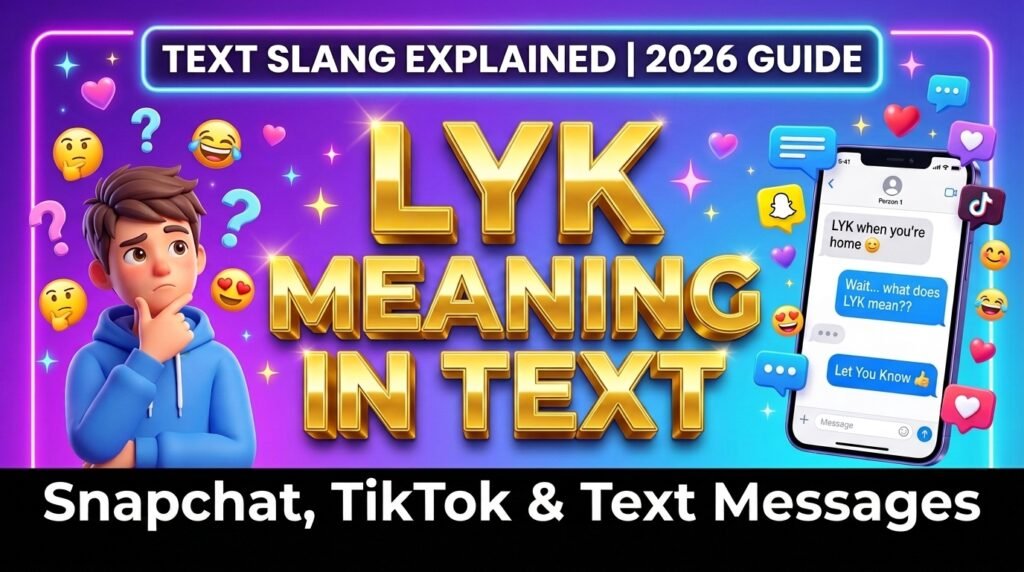

The meaning of LYK in text can be perplexing if it is the first time you saw it. The person sends you a message that simply says “lyk” and suddenly you are left wondering what they really meant by that text message. I have experienced something similar too-most of the time during conversations where you find the surrounding context of no assistance to you.
The thing with the meaning of LYK in text is that it’s not always the same. Depending on where you saw the term-a text message, Snapchat, Tik Tok comment, Instagram DM or group chat-it can have two very different meanings.
Once you read this guide, you will find out precisely what LYK means, how to find out which meaning is valid in a particular situation and how it is used usually.
Quick Answer: What Does LYK Mean?
Short version, no fluff: LYK usually means “Let You Know.” That’s the classic one, and it’s what you’ll see most in texts and DMs.
But there’s a second meaning that trips people up constantly “lyk” is also just a fast, casual way of spelling “like.” You’ll see this mostly in comments and captions, not standalone replies.
Here’s the rule of thumb I use: if “lyk” is sitting there by itself as a whole reply, it means Let You Know. If it’s tucked inside a sentence next to a verb or adjective, it’s almost certainly just “like.”
LYK Meaning #1: “Let You Know” (The Classic Meaning)
Definition & Core Use
This is the meaning most people already have some familiarity with. Someone uses LYK when they don’t have an answer yet but they’re promising one later.
It’s basically shorthand for “I’ll tell you once I find out.” Simple as that.
Say a friend asks if you’re free Saturday and you’re not sure yet you’d type something like “I’ll LYK once I check my schedule.” No drama, no confusion, just a placeholder for information that’s coming.
Real Chat Examples
Context changes the vibe, even though the meaning stays fixed. Here’s how it plays out across different relationships:
With a friend: “Are we still doing brunch?” “Not sure yet, I’ll LYK by tonight.”
A parent: “What time will you be home?” “Depends on traffic, I’ll LYK when I leave.”
A coworker: “Did the client sign off yet?” “Still waiting. I’ll LYK the second I hear back.”
With a classmate: “Did the professor move the deadline?” “No idea, I’ll LYK if I see an email.”
Notice the pattern? It almost always follows “I’ll” and stands on its own as the point of the sentence, not a description tucked inside one.
LYK Meaning #2: The Slang Spelling of “Like” (Content Gap: Big Differentiator)
Here’s the part almost nobody explains properly, and honestly, it’s probably the actual reason a lot of people end up confused in the first place.
“Lyk” isn’t always an acronym at all. Sometimes it’s just a stylized, quicker way people type the word “like” especially in comments, captions, and quick typing where autocorrect gets ignored on purpose.
Think about comments like “he lyk fr fr” or “not me lyk” or “I lyk that outfit.” None of those are about promising an update later. They’re just “like,” typed fast and a little sloppy, which honestly fits the whole vibe of casual internet writing.
From what I’ve seen scrolling through TikTok and Instagram comment sections for way too long, this usage is actually more common than the acronym version in casual content, even though almost every other guide online skips right past it.
Here’s a simple table to make the distinction stick:
| Clue | Meaning | Example |
|---|---|---|
| Stands alone as a full reply | Let You Know | “I’ll LYK.” |
| Comes right after “I’ll” or “I will” | Let You Know | “I’ll LYK once I hear back.” |
| Sits in the middle of a sentence | Like (slang spelling) | “He lyk never texts back.” |
| Followed by “fr,” “that,” or a description | Like (slang spelling) | “I lyk that so much.” |
If you’ve ever seen “lyk” and thought, “wait, that doesn’t sound like an acronym,” you were right. Sentence position is your biggest clue, every single time.
LYK Meaning on Snapchat
Snapchat has its own texting culture, and it’s a fast one. Messages disappear, streaks are constantly on people’s minds, and nobody’s writing full sentences if they can help it.
Both meanings of LYK show up here. In a Snap chat reply, LYK usually means Let You Know someone’s telling you they’ll update you once they know more, same as regular texting.
But in Snap captions or story text, you’ll sometimes see the “like” spelling version too, especially in short, punchy captions where full words feel unnecessary.
Example in a Snap chat: “Are you coming to the party tonight?” “Maybe, I’ll LYK after work.”
Example in a Snap caption: “this song lyk hits different”
Snapchat’s whole culture rewards speed over polish, which is exactly why abbreviations like LYK thrive there in the first place.
LYK Meaning on TikTok
TikTok is a slightly different animal because so much of the “texting” happening there isn’t really texting at all it’s comments, captions, and duet replies.
In the comment section, “lyk” is very often just the word “like,” dropped in fast while someone’s typing on their phone without a second thought about spelling.
Comment example: “this part lyk killed me 😭”
Caption example: “pov: he lyk actually meant it”
DMs on TikTok, on the other hand, tend to follow the same rule as regular texting LYK inside a direct message is usually Let You Know.
DM example: “Are tickets still available?” “Checking now, I’ll LYK in a sec.”
So on TikTok specifically, the format matters almost as much as the sentence structure. Comments and captions lean toward the “like” spelling; DMs lean toward Let You Know.
LYK in Text Messages, DMs & Group Chats
Outside of Snapchat and TikTok, LYK shows up constantly in regular texting iMessage, WhatsApp, Instagram DMs, Messenger, all of it.
Casual conversations are where you’ll see it most:
“Movie night still on?” “I’ll LYK once I finish this assignment.”
Family chats use it too, usually in a slightly more practical way:
“What time should I start dinner?” “Not sure yet, I’ll LYK when I leave the office.”
Even semi-professional workplace chats on Slack or Teams pick it up, though it’s more casual than you’d want in an actual email:
“Did the vendor confirm the order?” “Still pending, I’ll LYK by end of day.”
As for replying to it, keep it simple. A quick “sounds good” or “okay, thanks” works fine in casual settings. In work chats, something like “got it, thanks for the update” keeps things professional without sounding stiff.
| Situation | Example | Suggested Reply |
|---|---|---|
| Casual friend chat | “I’ll LYK tonight.” | “Cool, no rush!” |
| Family conversation | “I’ll LYK when I leave.” | “Okay, drive safe.” |
| Workplace chat | “I’ll LYK once it’s approved.” | “Sounds good, thanks.” |
How to Tell Which Meaning LYK Is (Quick Decision Guide)
If you want a shortcut for next time, here’s the three-step version I actually use myself:
- Is “lyk” standing completely on its own as the whole point of the message? That’s Let You Know.
- Is it sitting in the middle of a sentence, next to a description or feeling? That’s the “like” spelling.
- Still not sure? Check the platform. DMs and texts lean Let You Know. Comments and captions lean “like.”
It sounds almost too simple, but honestly, it works close to every time. Sentence position does most of the job for you.
Origin & History of LYK
The acronym version has a pretty predictable backstory it grew out of early SMS character limits and chatroom culture, back when every extra letter cost you effort (and sometimes literal money, if you remember pay-per-text days). “Let you know” got trimmed down the same way BRB, TTYL, and IDK did.
The slang-spelling version has a different, less talked-about origin. It’s less about saving characters and more about how people type quickly on phones without bothering to hit autocorrect’s suggestion “like” becomes “lyk” simply because it’s faster to type and feels more casual, almost like a stylistic choice rather than a shortcut.
Most guides only trace the first origin. Both threads matter here, since this term genuinely does double duty depending on where you’re reading it.
Is It Okay to Use LYK in Professional or Formal Writing?
Short answer: it depends entirely on the setting.
Casual workplace chat Slack messages, quick internal Teams pings LYK is generally fine. Nobody’s going to bat an eye at “I’ll LYK once I hear from the client” in a fast internal message.
Formal writing is a different story completely. Emails to clients, academic work, official documentation spell it out.
Before: “I’ll LYK once approved.” After: “I will let you know once it has been approved.”
Before: “LYK when you’re free.” After: “Please let me know when you’re available.”
A quick tip if you want safer professional alternatives: “I’ll keep you posted,” “I’ll follow up shortly,” or “I’ll confirm once I have more details” all read as polished without sounding cold.
LYK vs. Similar Texting Abbreviations
It helps to see LYK next to its cousins, because people mix these up more than you’d expect.
| Abbreviation | Meaning | Purpose |
|---|---|---|
| LYK | Let You Know | Promises a future update |
| IDK | I Don’t Know | Expresses current uncertainty |
| FYI | For Your Information | Shares info right now |
| BRB | Be Right Back | Signals a short absence |
| NP | No Problem | Casual acknowledgment |
The distinction that matters most: FYI gives information immediately, while LYK is a promise that information is coming later. IDK, meanwhile, is just admitting you don’t know no promise attached at all.
Common Mistakes People Make With LYK
The biggest one, by far: mixing up the two meanings mid-conversation and getting genuinely confused about what someone’s trying to say. This happens constantly, and honestly, most articles online make it worse by only explaining one meaning.
A few others worth flagging:
- Using LYK in formal emails where it just reads as unprofessional.
- Assuming every reader parents, coworkers, non-native speakers automatically knows the term.
- Stacking too many abbreviations in one message (“idk rn but ill lyk asap tbh”) until it stops being readable for anyone outside your immediate friend group.
A little balance goes a long way. Abbreviations save time, but only if the person on the other end can actually decode them.
For Parents & Non-Native English Speakers: Quick Decoder Note
If you’re a parent trying to make sense of your kid’s texts, or you’re learning English as a second language and keep running into this term don’t overthink it. LYK isn’t a red flag or anything concerning; it’s just casual shorthand.
Quick rule to remember: standing alone, it means “let you know.” Buried in a sentence, it’s just “like,” typed fast.
That’s genuinely all there is to it. No hidden meaning, no code you need to crack beyond what’s already covered here.
Alternative Ways to Say LYK
If you’d rather skip the abbreviation entirely, here are some solid replacements depending on the setting.
Casual alternatives:
- I’ll keep you posted
- I’ll get back to you
- I’ll update you
- I’ll tell you when I know
Professional alternatives:
- I will follow up shortly
- I will notify you once confirmed
- I will keep you informed
- I will provide an update as soon as possible
Save that second list for your next work email it reads clean without sounding overly formal.
Frequently Asked Questions
What does LYK meaning in a text message? It usually means “Let You Know” a way of saying you’ll share more information once you have it.
What does LYK mean on Snapchat? In Snap chats, it’s typically Let You Know, same as regular texting. In captions, it can sometimes just mean “like.”
What does LYK mean on TikTok? In comments and captions, it’s often just the word “like” typed fast. In DMs, it usually means Let You Know.
Does LYK always mean “Let You Know”? No. If it’s sitting inside a sentence rather than standing alone, it’s more likely a casual spelling of “like.”
Why do people spell “like” as “lyk”? It’s mostly a quick, casual typing habit faster to type and it fits the informal tone of comments and captions.
Is LYK the same as IDK or FYI? No. IDK expresses uncertainty, FYI shares information immediately, and LYK promises information later.
How do you reply to LYK? A simple “sounds good” or “okay, thanks” works for casual chats. For work chats, “got it, thanks for the update” is a safe bet.
Is it rude to send just “LYK”? Not at all. It’s considered friendly and low-pressure it just signals you’ll follow up when you can.
Can LYK be used in a work email? Generally, no. Spell out “I will let you know” for anything formal or client-facing.
How do I say LYK out loud as letters or a word? Most people say it letter by letter “L-Y-K” rather than pronouncing it as one word.
Is LYK still used in 2026, or is it outdated? Still very much in use, especially in texting and DMs. The “like” spelling version, if anything, has only gotten more common in comments and captions.
Conclusion:
So, to recap where we landed: LYK isn’t a one-meaning term, no matter what most guides tell you. It splits into two real uses depending on where you’re reading it.
- LYK standing alone in a text or DM almost always means “Let You Know.”
- “Lyk” tucked inside a sentence, especially in comments or captions, is usually just a fast spelling of “like.”
- Snapchat and TikTok DMs follow the first rule; comments and captions lean toward the second.
- Sentence position is your fastest, most reliable clue when you’re unsure.
- It’s fine for casual chats and informal work messages, but swap it out for full phrasing in anything formal.
Next time “lyk” shows up in your notifications, you’ll know exactly which one you’re dealing with no more guessing games. If you’ve spotted it used a different way, drop it in the comments; I’m always curious how this stuff keeps shifting.
About The Author