Admin
Admin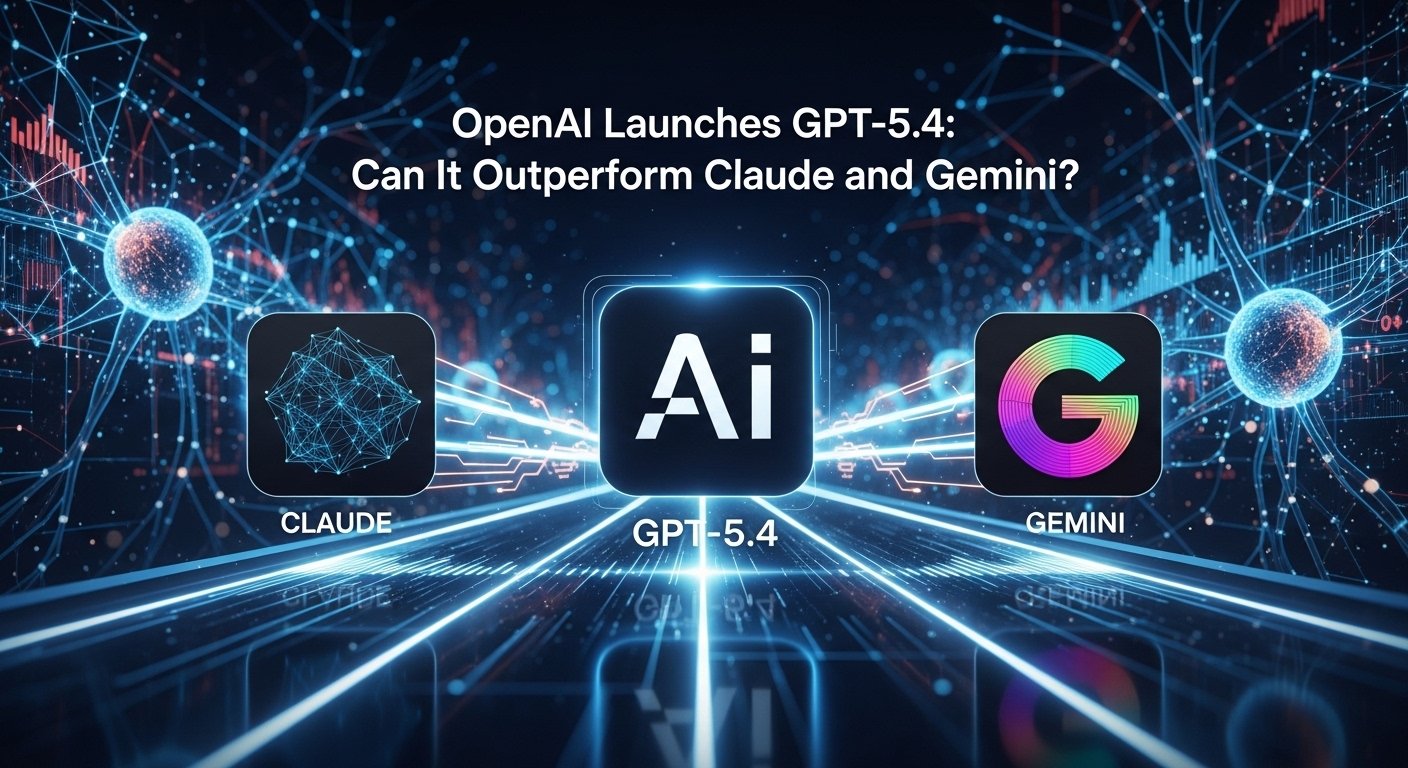
OpenAI has launched GPT-5.4 acknowledging the rate at which AI has evolved over the past few years is a bit dizzying. It seems like there’s a new model out almost every few months with claims of better reasoning, faster responses, or better coding capabilities. Now it’s time to focus on GPT-5.4, the newest release from OpenAI.
The news of the GPT-5.4 launch has caused a new controversy in the AI community. Developers are benchmarking, creators are experimenting on writing quality and businesses are questioning whether this new model can substitute the current AI tools in their work.
There is more to it than that. The competition in the AI industry is practically a three-way battle between OpenAI, Anthropic and Google. Their flagship products (Claude AI and Google Gemini) have also been getting better at an accelerated pace.
Therefore, the question, which people pose over and over again, is quite simple: is GPT-5.4 able to compete with Claude and Gemini?
Let’s break it down.
What is GPT-5.4?
Overview of the New Model
In principle, GPT-5.4 is a large language model, which is a next-generation developed by OpenAI that is more focused on enhancing reasoning, coding capacity, and multimodal cognition.
Similar to previous architectures in the GPT-5 family, it is built around superior transformer architecture. This update however is much more practical performance-related such as accuracy, speed, and contextual understanding.
This is where AI advancement is taking place, in my view through the newer models that have been tested recently. It is not so much about glamorous displays but rather it is the dependability in daily chores.
Key Improvements Over Previous GPT Versions
Compared to older GPT models, GPT-5.4 introduces several noticeable improvements:
- Stronger reasoning for complex prompts
- Better code generation and debugging
- Expanded multimodal understanding (text, images, and structured data)
- Faster responses under heavy workloads
- Improved contextual memory for longer conversations
Many developers also suspect that GPT-5.4 includes a larger context window and better training optimization. While exact details are often limited, early tests suggest more stable outputs and fewer hallucinations.
Read Related Article: https://garminlive.com/incogni-vs-kanary-which-actually-protects-your-privacy-in-2026/
Key Features of GPT-5.4
Advanced Reasoning
One of the biggest upgrades is improved logical reasoning.
The model handles multi-step problems more consistently—things like planning workflows, solving technical questions, or analyzing documents.
For example, instead of giving shallow answers, GPT-5.4 often breaks down problems step-by-step. That’s a small change that makes a big difference in real work scenarios.
Better Coding Assistance
Developers will likely notice this improvement immediately.
GPT-5.4 works well for:
- debugging Python or JavaScript errors
- generating code snippets
- explaining unfamiliar APIs
- converting code between languages
In my experience testing AI coding assistants, the real value isn’t just writing code—it’s understanding why the code works. GPT-5.4 seems noticeably better at explaining logic.
Improved Multimodal Capabilities
Another key improvement is multimodal understanding.
GPT-5.4 can analyze and respond to different data types such as:
- text documents
- images
- charts and diagrams
- structured datasets
This makes the model useful for tasks like interpreting reports, analyzing screenshots, or summarizing visual data.
Faster and More Accurate Responses
Speed matters more than people realize.
Early tests show GPT-5.4 delivering quicker responses while maintaining better accuracy. For teams using AI inside productivity tools, even a few seconds saved per interaction adds up quickly.
GPT-5.4 vs Claude vs Gemini
Performance Comparison
Here’s a simplified comparison of the three major AI models currently competing for the top spot.
| Feature | GPT-5.4 | Claude | Gemini |
|---|---|---|---|
| Developer Ecosystem | Strong API ecosystem | Growing rapidly | Integrated with Google products |
| Reasoning Ability | Very strong multi-step reasoning | Excellent long-context reasoning | Balanced reasoning |
| Coding Support | Excellent for developers | Good but less technical | Improving quickly |
| Multimodal Features | Strong multimodal tools | Primarily text focused | Very strong image/video integration |
Each model has strengths depending on the use case.
Accuracy and Reasoning
Claude AI is widely known for long-context reasoning and document analysis.
Meanwhile, GPT-5.4 seems optimized for a mix of reasoning and productivity tasks. From what many testers report, it handles structured prompts and technical problems extremely well.
Google Gemini performs strongly in multimodal environments, especially when connected to Google services.
Coding and Developer Experience
For developers, GPT-5.4 may currently have the edge.
OpenAI has spent years building an ecosystem of APIs, developer tools, and integrations. That infrastructure makes it easier to embed the model into real applications.
Claude is catching up quickly though, especially in enterprise environments.
Real-World Use Cases
In real-world scenarios:
- GPT-5.4 works well for coding, writing, and automation.
- Claude excels at document analysis and safety-focused tasks.
- Gemini shines when integrated with Google tools like Docs or Gmail.
So the “best AI model” often depends on the workflow.
Use Cases – Who Can Benefit From GPT-5.4?
Content Creators
Bloggers, marketers, and YouTubers can use GPT-5.4 for:
- blog outlines
- SEO content drafts
- video scripts
- content repurposing
I’ve personally seen creators reduce research time dramatically by using AI assistants for early drafts.
Developers and Programmers
Developers benefit from:
- debugging assistance
- API explanations
- code generation
- documentation summaries
Instead of searching forums for hours, many programmers now treat AI as a coding partner.
Businesses and Marketing Teams
Companies are using GPT-5.4 for:
- email writing
- customer support automation
- marketing copy generation
- internal knowledge assistants
Small startups especially benefit because AI tools can handle tasks that normally require multiple employees.
Students and Researchers
Students use GPT-5.4 as a learning companion.
Common tasks include:
- summarizing academic papers
- explaining difficult concepts
- generating study notes
- analyzing datasets
The key is using AI as support, not as a shortcut for learning.
Tips to Get the Best Results from GPT-5.4
Write Clear Prompts
AI performs best when prompts are specific.
Example prompt:
“Summarize this article in five bullet points and highlight key statistics.”
Clear instructions produce clearer responses.
Use Step-by-Step Instructions
Complex tasks work better when broken into steps.
Example:
- Analyze the problem
- Suggest solutions
- Compare advantages
This structure improves reasoning output.
Combine AI with Human Editing
This is an aspect that is ignored by many people.
Artificial intelligence is capable of coming up with powerful drafts, yet human editing is still required. The inclusion of personal information, tonality corrections, and fact verification make the content reliable.
Possible shortcomings and concerns.
Precision and Hallucinations.
Even such sophisticated models as GPT-5.4 sometimes provide inaccurate information.
This is the problem that is commonly referred to as AI hallucination; it needs to be carefully fact-checked.
Ethical and Privacy Issues
Privacy is also another concern by organizations using AI tools.
Considerable data must never be disseminated without due protection. The responsible use of AI becomes one of the company policies.
AI Dependence Risks
The other issue is the excess dependence on AI.
In the event that users over-rely on automated systems, the skills of critical thinking can be impaired. The use of AI must be in assisting human decision making rather than taking over.
Read Related Article: https://garminlive.com/best-data-broker-removal-services-in-2026-full-guide-comparison/
The Future of AIs models following GPT-5.4.
The AI innovation race is not decreasing.
As businesses, such as open AI, Anthropic, and Google, begin competing with each other, the next generation of models will probably emphasize greater reasoning, a more prominent memory, and enhanced real-world trustworthiness.
Other scholars have started to talk about the potential form of GPT-6.
My personal expectation is that it will add the most in the form of improved integration with more common applications: email, code editors, research systems, and productivity markets. The time when AI assistants become a part of the working process, is when their worth is seen.
FAQs
What is GPT-5.4 and how is it different from GPT-4?
GPT-5.4 is a more recent large language model offered by OpenAI that has more reasoning, quicker reply, better coding, and multimodal comprehension. It is more concerned with accuracy, context processing and productive work as compared to GPT-4.
Is GPT-5.4 better than Claude and Gemini?
It depends on the use case. GPT-5.4 is good at coding and overall productivity, whereas Claude AI is good at long-context reasoning and Google Gemini is good in multimodal and Google-integrated systems.
What are the main features of GPT-5.4?
Major characteristics of GPT-5.4 are enhanced reasoning, enhanced coding support, stronger multimodal, quicker replies, enhanced understanding of the context, and higher quality of conversation.
Who should use GPT-5.4?
GPT-5.4 can be useful to developers, content creators, businesses, students, and researchers. It assists in writing, codification, research, automation and productivity.
How can I access GPT-5.4?
GPT-5.4 is normally accessible on OpenAI websites, APIs, and artificial intelligence assistant applications. The means to access it can be different as per the subscription plans or integrations with developers.