
HR software has come a long way from clunky payroll systems and static employee databases. What I’ve seen over the past few years is a clear shift toward smarter, more connected systems. In 2026, enterprise HR software isn’t just about managing employees it’s about understanding them.
AI in HR software is no longer experimental. It’s baked into hiring, performance tracking, and even retention strategies. Add automation, global workforce demands, and compliance complexities, and you start to see why choosing the right system matters.
Honestly, choosing the right HR system can make or break your HR strategy. I’ve seen companies scale smoothly with the right tools and others struggle because they picked software that couldn’t grow with them.
What is Enterprise HR Software?
At its core, enterprise HR software is a system designed to manage all HR processes for large organizations usually thousands of employees, often across multiple countries.
You’ll hear terms like HRIS, HCM, and HRMS thrown around:
- HRIS (Human Resource Information System): Focuses on core data employee records, payroll, compliance
- HCM (Human Capital Management): Broader, includes talent management, performance, learning
- HRMS (Human Resource Management System): Often used interchangeably, but usually combines both
A simple example: a global company hiring in five countries needs payroll, compliance, onboarding, and performance tracking all in one place. That’s where enterprise HR platforms come in.
Read more: https://garminlive.com/top-10-b2b-marketing-trends-in-2026/
Key Features to Look for in Enterprise HR Software
Core HR Features
These are non-negotiables:
- Employee database management
- Payroll automation
- Benefits administration
- HR compliance tracking
- Employee lifecycle management
- Onboarding workflows
- Document management
If a platform struggles here, it’s not enterprise-ready.
Advanced Features
This is where things get interesting:
- AI HR tools for hiring and retention
- Predictive HR analytics
- Performance management systems
- Workforce planning tools
- Succession planning
- Employee engagement dashboards
From what I’ve seen, companies that actually use these features not just pay for them get the most ROI.
Integration & Scalability
Many people overlook this and regret it later.
- API-based integrations
- Compatibility with finance and IT systems
- Multi-location and global support
- Custom workflows
If your HR system can’t integrate, it becomes a bottleneck fast.
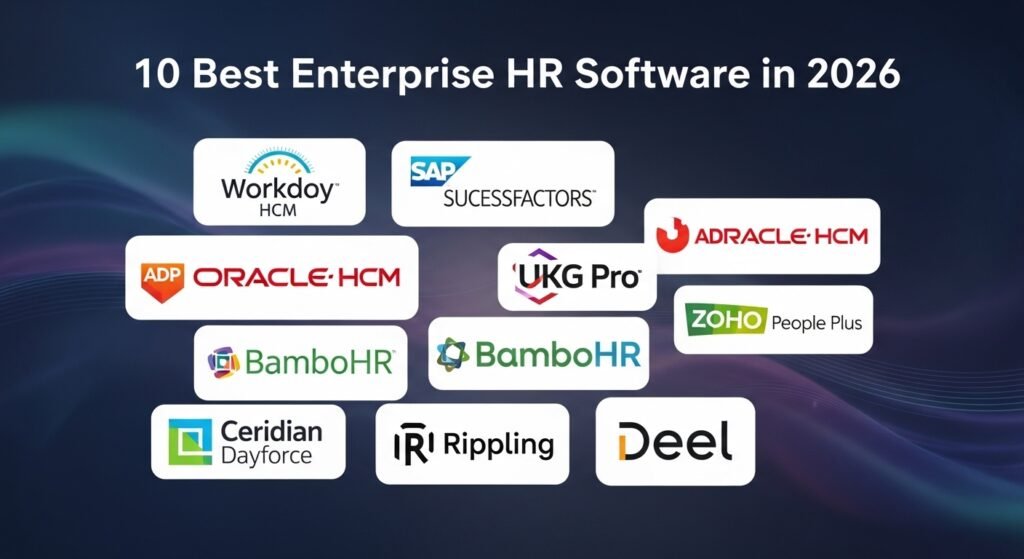
The 10 Best Enterprise HR Software in 2026 (Compared & Ranked)
1. Workday HCM
Still the gold standard for large enterprises.
Pros: Powerful analytics, scalable, strong payroll
Cons: Expensive, complex setup
Best for: Large global enterprises
2. SAP SuccessFactors
A solid choice for companies already using SAP.
Pros: Deep workforce management, global compliance
Cons: Interface can feel dated
Best for: Enterprise ecosystems
3. Oracle HCM Cloud
Strong in automation and AI-driven insights.
Pros: Advanced analytics, flexible modules
Cons: Learning curve
Best for: Data-driven HR teams
4. ADP Workforce Now
Reliable and widely used.
Pros: Payroll expertise, compliance tools
Cons: Limited customization
Best for: Payroll-heavy organizations
5. UKG Pro (Ultimate Kronos Group)
Great for workforce management.
Pros: Time tracking, scheduling
Cons: UI could be better
Best for: Operations-heavy companies
6. BambooHR (Enterprise Plan)
Surprisingly capable for scaling companies.
Pros: Easy to use, fast implementation
Cons: Not as deep for large enterprises
Best for: Mid-to-large businesses
7. Zoho People Plus
Budget-friendly but powerful.
Pros: Affordable, customizable
Cons: Limited enterprise depth
Best for: Cost-conscious companies
8. Ceridian Dayforce
Strong payroll + analytics combo.
Pros: Real-time data, workforce insights
Cons: Implementation can be slow
Best for: Data-focused HR teams
9. Rippling
A newer player, but impressive.
Pros: Combines HR + IT management
Cons: Can get pricey with add-ons
Best for: Tech-forward companies
10. Deel (Global HR & Payroll)
Best for remote and global teams.
Pros: Global payroll, compliance
Cons: Limited traditional HR features
Best for: Distributed teams
Comparison Table (Quick Overview)
| Software | Best For | Pricing | Key Feature |
|---|---|---|---|
| Workday HCM | Large enterprises | High | Advanced analytics |
| SAP SuccessFactors | SAP users | High | Global compliance |
| Oracle HCM | Data-driven HR | High | AI insights |
| ADP Workforce Now | Payroll-focused orgs | Medium | Payroll automation |
| UKG Pro | Workforce management | Medium | Scheduling tools |
| BambooHR | Scaling companies | Medium | Ease of use |
| Zoho People Plus | Budget teams | Low | Custom workflows |
| Ceridian Dayforce | Analytics-heavy teams | Medium | Real-time data |
| Rippling | Tech companies | Medium-High | HR + IT integration |
| Deel | Remote teams | Medium | Global payroll |
How to Choose the Right Enterprise HR Software
Based on Company Size
- Large global enterprise → Workday or SAP
- Mid-to-large scaling → BambooHR or Rippling
- Distributed teams → Deel
Based on Budget
- High budget → Workday, Oracle
- Mid-range → ADP, UKG, Ceridian
- Lower budget → Zoho People
Overpaying for features you won’t use is more common than you’d think.
Based on Use Case
- Payroll-heavy → ADP or Dayforce
- Talent management → Oracle or SAP
- Remote workforce → Deel
- All-in-one modern stack → Rippling
Read more: https://garminlive.com/cloud-vs-local-storage-which-one-is-better-for-you-in-2026/
Benefits of Using Enterprise HR Software
- Reduces manual work through automation
- Improves compliance across regions
- Centralizes employee data
- Enhances decision-making with analytics
- Boosts employee experience
- Supports workforce planning
I’ve personally seen HR teams cut admin workload by half after switching to the right system.
Common Mistakes to Avoid
- Choosing based only on brand name
- Ignoring scalability
- Not checking integrations
- Overlooking user experience
- Rushing implementation
One mistake that stands out: companies buying enterprise software but using only 20% of its features.
Future Trends in Enterprise HR Software (2026 & Beyond)
A few trends are already shaping the next phase:
- AI-driven hiring decisions
- Predictive analytics for retention
- Employee experience platforms
- Tools for remote and hybrid teams
- Increased focus on HR automation
HR tech evolution is leaning toward personalization systems that adapt to employees, not the other way around.
FAQs
What is the best enterprise HR software in 2026?
It depends, but Workday, SAP SuccessFactors, and Oracle HCM are leading for large enterprises.
How much does enterprise HR software cost?
Pricing varies widely. Expect anywhere from mid five-figures annually to significantly higher for global systems.
Which HR software is best for global teams?
Deel stands out for global payroll and compliance. SAP and Workday also handle global needs well.
Is cloud-based HR software better?
In most cases, yes. Cloud HR software offers better scalability, updates, and accessibility.
Can HR software improve employee productivity?
Yes especially when automation reduces admin tasks and employees get self-service tools.
Final Thoughts & Recommendations
If I had to narrow it down:
- Best overall: Workday HCM
- Best for global scale: SAP SuccessFactors
- Best modern platform: Rippling
The right choice really depends on your company’s size, complexity, and growth plans. But one thing is clear enterprise HR software in 2026 isn’t optional anymore.
Choose smart, scale faster.
About The Author